Police are Now Confiscating DJ Laptops as “Evidence’ for Illegal Parties-What’s next?
via Davey D of
HipHopPolitics & via Joshua Emerson Smith of
The San Fransisco Bay Guardian
 I wanna make sure that every DJ reading this pays close attention and doesn’t dismiss this. Its all about setting legal precedent so police can take things a step further. This is pointed out in the article.
Every DJ reading this needs to realize that this so-called collection of evidence will eventually start happening when the RIAA and the organizations it backs (I.e. Music First Coalition, Sound Exchange etc) began tracking down DJs who aren’t paying licensing fees for their music, especially if they are rocking at these ‘underground’ parties. This will really happen if they manage to push John Conyers bill HR 848 and make that into law.
For those who don’t know, HR 848 is a performance tax they want to charge radio. Play a song on the air and the artist (translation really the label using the artists as fronts) should get some money. This talk about playing songs for promotional purposes has fallen on def ears as far as the labels are concerned. Once this bill passes they will then use this argument of ’precedent’ and make the case that since radio is paying a performance license so should deejays and club venues. This argument of ‘precendence‘ is the same scurrilous tactic they are using now to try and pass HR 848, except they are pointing to the highly contested bill that made internet and satellite radio pay similar fees as justification. They are likely to argue that the DJ is making living off the backs of hardworking artists and that there would be no career if it wasn’t for the artist thus an artist should share in a percentage of the revenues. Keep your eyes open..
Lastly I will remind people if you recall when the RIAA started cracking down on mixtapes being sold in open markets they were able to do something that almost every business I know of has not and can not. They been able to come along with law enforcement on those RAIDS as if they were the police themselves. I also want folks to check to see if some sort of tracking devices or software are not being added to the laptops when they are returned.
-Davey D-
Controversial tactic of taking laptops even when DJs not charged with crime reportedly condoned by San Francisco’s new chief of police. EEF attorney steps in to help protect DJs privacy, get computers back.
San Francisco Bay Guardian
I wanna make sure that every DJ reading this pays close attention and doesn’t dismiss this. Its all about setting legal precedent so police can take things a step further. This is pointed out in the article.
Every DJ reading this needs to realize that this so-called collection of evidence will eventually start happening when the RIAA and the organizations it backs (I.e. Music First Coalition, Sound Exchange etc) began tracking down DJs who aren’t paying licensing fees for their music, especially if they are rocking at these ‘underground’ parties. This will really happen if they manage to push John Conyers bill HR 848 and make that into law.
For those who don’t know, HR 848 is a performance tax they want to charge radio. Play a song on the air and the artist (translation really the label using the artists as fronts) should get some money. This talk about playing songs for promotional purposes has fallen on def ears as far as the labels are concerned. Once this bill passes they will then use this argument of ’precedent’ and make the case that since radio is paying a performance license so should deejays and club venues. This argument of ‘precendence‘ is the same scurrilous tactic they are using now to try and pass HR 848, except they are pointing to the highly contested bill that made internet and satellite radio pay similar fees as justification. They are likely to argue that the DJ is making living off the backs of hardworking artists and that there would be no career if it wasn’t for the artist thus an artist should share in a percentage of the revenues. Keep your eyes open..
Lastly I will remind people if you recall when the RIAA started cracking down on mixtapes being sold in open markets they were able to do something that almost every business I know of has not and can not. They been able to come along with law enforcement on those RAIDS as if they were the police themselves. I also want folks to check to see if some sort of tracking devices or software are not being added to the laptops when they are returned.
-Davey D-
Controversial tactic of taking laptops even when DJs not charged with crime reportedly condoned by San Francisco’s new chief of police. EEF attorney steps in to help protect DJs privacy, get computers back.
San Francisco Bay Guardian
Police seize DJs’ laptops
New police chief apparently condones policy that critics call illegal and punitive
By Joshua Emerson Smith
news@sfbg.com
 San Francisco Police Department
 officers have added a controversial tactic to their aggressive raids on house parties (see “Fun under siege,” 4/22/09): they’re seizing laptop computers from DJs at the events.
While SFPD officials deny the laptop seizures is a new policy, they admit it has been condoned by
Police Chief George Gascón, who took over in August and last month told the
Guardian’s editorial board he wants to make the SFPD more transparent and accountable to the public (see “New coach, new approach,” 10/14/09).
“The police chief is aware that officers are being proactive in gathering evidence,” Sgt.
Lyn Tomioka told the
Guardian when asked about a string of laptop seizures by undercover cops over the last 10 months, most of them in cases in which the DJs weren’t even charged with a crime.
Many of the raids have occurred in SoMa, and were spearheaded by undercover officers who penetrated the parties and were followed by uniformed officers.
San Francisco Entertainment Commission member
Terrance Alan called the crackdown a “disappointing and dangerous trend.”
Tomioka said it’s a judgment call for officers to seize laptops as evidence of an illegal party, but Alan said the tactic is a punitive measure that proves nothing: “Taking laptops [is] not necessary to prove the underlying crime, and in many cases damages people’s ability to earn a living.”
One of the most recent raids happened on Halloween. It was about 2:30 a.m. and music was pumping out of a warehouse party on Sixth Street. The people throwing the party had hired a doorman, and attendee Eric Dunn was standing in line waiting to get in.
“We were right at the front of the line,” Dunn told the
Guardian, when
, he said, two plainclothes officers drove up on the sidewalk, jumped out of an unmarked car, and rushed up to the doorman. “[The officers] pretty much started demanding entry right away. The doorman was really polite. He basically told them that you have to know somebody to get into the party.”
Dunn said the officers waited until an exiting guest opened the door from the inside and then made their move. “One guy barged in, and the other guy followed. They never asked permission or received permission to enter the building,” Dunn said.
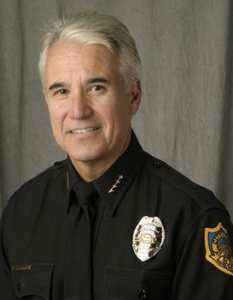
SF Chief George Gascon is allowing his officers to confiscate laptops from DJs as 'evidence'
Inside, the two undercover officers immediately shut down the event.
Justin Miller, a DJ at the event, said she remembers it very clearly. “The cops at that point were telling everybody to leave the party, telling me to turn the music off. I turned the music off. Everyone was quietly leaving.”
But Miller said it didn’t stop there. One of the undercover officers approached her and asked if she had a laptop. She said she did. “I was a little confused at this point because I didn’t know what my laptop had to do with anything. I was playing CDs.” She said she pulled her computer out from underneath a table and unzipped it from a case. The officer then “grabbed it from me.”
The undercover police officer — later identified by witnesses and the evidence receipt as
Larry Bertrand — instructed Miller to follow him down to the street to get a property receipt for her laptop.
At this point there were uniformed officers on the scene as well. Miller started to cry. “I begged him. I said, ‘This is my livelihood. You’re talking my laptop. This is my livelihood. I hope you realize that.’ He said, ‘This is how you’re going to learn then, I guess.’”
Miller said Bertrand (who did not return
Guardian calls for comment) then told her he was “going to take it upon himself to shut down every illegal party in San Francisco.”
She said he then opened the trunk of his car, revealing several other laptops. A person at the party pointed out that one of the laptops belonged to a friend of his, and asked if he could get the property receipt for the laptop. Miller said Bertrand turned to the inquiring person and said, “You will never see this laptop again.”
She continued: “He then looked at me and said, ‘I’m going to make sure your paperwork gets so tied up that maybe you won’t see this laptop until December, January, February, who knows when.’ I felt so violated.”
Miller has been working as a DJ in the Bay Area, under the name
DJ Justincredible, for more than 10 years. She says she’s never had any of her equipment confiscated by the police before. But at that party, three DJs had their laptops confiscated, even though none were charged with a crime.
Shortly after the Halloween incident, Miller and the two other DJs who were at the party contacted the
Electronic Frontier Foundation, a nonprofit advocacy group specializing in technology and privacy issues.
Jennifer Granick, a civil liberties lawyer with EFF, said most people haven’t heard about this because few of these DJs, if any, ever get convicted of a crime.
“DJs and the police department know that sound equipment and laptops are being unlawfully seized. But the public and the courts haven’t heard much about it because every time a DJ asks for a hearing, the cops just give them their property back rather than show up and defend the practice in open court before a judge,” she said.
Sean Evans has been working as a DJ in San Francisco, under the name
DJ 7, for more than 10 years. He said that over the summer he had his laptop seized by police during an after-hours party in SoMa. He was given no property receipt, and his case was dismissed. But it took him three months to get his computer back.
“To lose our sole means of income, it’s a huge setback. It puts us out of work. In this recession, we’re struggling, and we need our laptops to get by,” he said. Evans grew up in the Bay Area and he said has never had anything like this happen to him before.
Granick argued it is illegal for police to seize property without issuing citations or arrests. She also said there are serious privacy issues at stake. “If we were to find out that the police were doing something else with the laptops, like searching through them or copying the data, we would definitely go to court,” she said.
SFPD
Sgt. Wilfred Williams said he could not say what was currently being done with the laptops. In general, he said, private events that emit “extraordinary amounts of sound” need permits. And if they don’t have the proper permits, he said, property can be seized as evidence, “be it the speakers, be it the laptops, be it a mixer.”
Both Tomioka and Williams say the seizures aren’t a new policy. “If you look back in time, laptops haven’t been used for music,” Williams said. “There used to be old types of equipment that was taken in the past. But now laptops are being used. So yes, today, laptops [are] being seized.”
Entertainment advocates have called on
Mayor Gavin Newsom and Gascón to come forward with an explicit policy concerning these raids and seizures. The Mayor’s Office did not respond to
Guardian inquiries. Critics of the policy say it’s having a chilling effect on nightlife in San Francisco.