
Showing posts with label Copyright. Show all posts
Showing posts with label Copyright. Show all posts
Thursday, April 22, 2010
RiP! A Remix Manifesto (Feature Film)
Filmmaker Brett Gaylor explores issues of copyright in the information age, mashing up the media landscape of the 20th century and shattering the wall between users and producers.


Saturday, April 3, 2010
Fair Use Gets a Fair Shake in Second Life - (EFF.org)
Fair Use Gets a Fair Shake in Second Life
Kudos to Linden Lab, which has just release an update to the Terms of Service for their virtual world, Second Life, that includes language that will protect fair use of screenshots and machinima. The new Snapshot and Machinima Content License grants Linden Lab and other users of Second Life a license to use “in snapshots and machinima your Content that is displayed in-World in publicly accessible areas of the Service.”
Machinima, which refers works that use real-time 3-D graphics engines to generate computer animation, could have presented a special problem for Second Life, where every individual object in view is potentially a different person’s intellectual property. Getting permission from so many owners of IP in order to create a machinima is potentially nightmarish. Instead of running from the new kinds of fair use enabled by new technologies, Linden Lab has embraced them. The new license allows Second Life users to reserve the rights to their creations by placing them in areas that are not publicly accessible. Second Life makes tools available to users that allow them to restrict access to their Virtual Land and its contents. The rules are simple and intuitive: if you don’t want people taking pictures of your floating city/dancing bear/epic space opera, don’t leave your floating city/dancing bear/epic space opera in a public place.
Linden Lab’s behavior should be an object lesson to movie studios and major record labels, who have alienated their own fans by trying to thwart new fair uses as they come along, whether through DRM or DMCA takedowns. Linden Lab has shown that there are innovative new ways to give the green-light to fair uses while still giving users the freedom to protect their creations. We hope that movie studios and major record labels are taking notes, because Linden Lab is showing them how it’s done.
Wednesday, February 24, 2010
Practical Advice for Music Bloggers Worried About DMCA Takedown Censorship

Let's say you are a blogger who writes about music regularly and includes links to music in your posts. How do you avoid having your blog censored off the Internet by "DMCA takedown notices" sent out by music industry lawyers (as happened last week to several blogs hosted by Blogger)?
Of course, you could get authorization from all the relevant copyright owners before you post or link to a song. Unfortunately, that's virtually impossible for many music bloggers. In some cases, it may be impossible to figure out who the copyright owners are (consider the problem of live concert bootlegs, rare B-sides, out-of-print material, defunct labels). In other cases, you might have authorization from someone, but it could end up being the wrong person (i.e., an independent promoter or member of the band who doesn't actually have all the rights to give you). And even if you get authorization from all the right people, you could still find yourself on the receiving end of a DMCA takedown from the entity that controls the copyright in another country (because your blog can be accessed from that country).
In other words, it's quite likely that many music bloggers can never be sure that a DMCA takedown notice won't arrive someday.
If one does arrive, your blog hosting service probably won't take your side. The law gives online hosting services strong incentives to comply with takedown notices—prompt responses to takedown notices are often the only reliable shield that hosting services have against copyright infringement lawsuits and potentially hundreds of thousands of dollars of damages. No matter how much your hosting service values your business, it is not likely that they will be willing to bet their business to save your blog.
While most hosting providers will let you send a "DMCA counter-notice" to contest a bogus takedown notice, sending a counter-notice can have serious consequences if you're not absolutely sure that you had all the necessary legal rights to post the songs or links in question. Sending a DMCA counter-notice is serious business, as it leaves the copyright owner with few options (other than suing) in order to keep the song down. So we recommend that bloggers research copyright law and, if in doubt, consult a qualified attorney (or contact EFF) before sending DMCA counter-notices.
The DMCA also gives hosting services strong incentives to "terminate repeat infringers." That's why most blog hosting services will delete your account (and thus your entire blog) after receiving multiple DMCA takedown notices. The industry norm seems to be a "3 strikes" policy, although the number of "strikes" can vary. This policy can be particularly unfair when a copyright owner sends multiple DMCA takedown notices all at once, or within a few days of each other — you can find your blog deleted before you even find out who was complaining or can send a DMCA counter-notice. Many hosting providers also mark every DMCA takedown notice on your "permanent record" — simply deleting the file or the link won't expunge the "strike" on your account (generally, only a DMCA counter-notice will do that). So a DMCA takedown notice received for your blog might still count as a "strike" years later (again, this is because service providers want to be able to tell a court that they were good about "terminating repeat infringers," lest they lose their shield against copyright infringement lawsuits).
Of course, you may be able to talk the copyright owner into withdrawing a DMCA notice ("your marketing department sent me an email saying this link was legit"). And there may be informal strategies that work most of the time (like deleting links after a short period of time). However, at the end of the day, it's nearly impossible to be sure you'll never receive a DMCA takedown notice.
With that in mind, here are a few practical things you can do to minimize the disruption that the DMCA process might inflict on your blog:
READ THE FULL ARTICLE HERE
Tuesday, January 19, 2010
5 Ways to Capitalize on James Cameron's "Avatar" in Virtual Worlds

Massively wrote a great follow-up on this hoopla called "The Sea Monkey experience of Avatars"
"Virtual environments can be beautiful, can exhibit grace, and can be immersive and fascinating and useful in all sorts of different ways ... but if you've got the 'Avatar blues', it's like buying Sea Monkeys and getting Artemia salina × nyos.
We don't expect actual user-retention in any virtual environment to rise significantly in the wake of this. We expect that the number of retained Pandora-piners will be about the same percentage as retention for pretty much any other general demographic. Sea Monkeys can be pretty awesome, make no mistake. They just might not be what you really want.
In the meantime, there's a lot of designers across several virtual environments who are making a lot of money copying skins, designs and settings from the film."
Here is my list of 5 ways you can try to make a buttload of cash by riding the blue glowing wave of "Avatar" and it's popularity.
1) Turn the crap you were selling into the color blue (and make it glow!).
That's right... any content you were selling before can now be official Na'vi "Avatar" content by changing it to the color blue, making it glow, and by changing the title of the object. Look, I did it here:

What was once a wood box called "Object" is now
an Official "Avatar" glowing blue prim called:
"Pandora's Box" ... on sale now....
(If you would like the x-rated version,
these Na'vi prims are also for sale at Zindra,
coincidentally also named "Pandora's Box")
2) Change the avatar skins you were selling to the color blue.
If you were a skin designer or avatar designer, all you have to do is add blue versions to your product line... and of course, call those skins "Na'vi"

Hot "Avatar" tail.... mmm...
In case the designers out there are wondering, the code for Na'vi skin is
H: 203 | S: 63 | B: 69 | R: 66 | G: 134 | B: 177
3) Create a Na'vi role-player group. Then create a role-player test in order to gain exclusive entry.
Similar to the Bloodlines business model: Create a role-player group, something like Na'vi of Second Life or Pandora Roleplay. Then, in order for avatars to become official members of the Na'vi role-player clan, they will have to shop and purchase the Na'vi avatars, and Pandora pixels in order to gain exclusive access into the group.

"I just need to buy 10 more spirits from the Sacred Tree of Souls,
then I know they'll let me in."
4) Redesign the spaceship you were selling to look like the mercenary helicopters from the movie.
Remember that rocket ship or helicopter you once made? Well strap on two large ceiling fans to the side, and now you have a human mercenary ship from the movie ready to be sold.

5) Advertise on your website (and make sure the ad has a picture of a blue avatar in it).
Finally, of course.... keep plugging! Advertise the blue. Ride the blue wave. Anything that is blue and says "avatar" on it is a gold mine in clicks
---
Although this blog post is meant to be tongue-and-cheek, I am also trying to point out that the creativity and imagination within a virtual world, and within people's minds, can be limitless. The new "Avatar" designs appearing in Second Life are quite detailed and expertly crafted. For example, "Pandora - Na'vi ' Planet Avatar" on the Pegase sim did a great job.
However, Second Life is practically limitless. Second Life has been around for 6 years!! Anything can be created, and usually, anything and everything IS created.... but, don't sell yourself short by jumping on the "Avatar" Na'vi bandwagon. "Avatar" is James Cameron's brain-child. Why copy it? Why not create a world of your own using Second Life (or Open Sim, or any virtual world platform) to explore your own creative, artistic, and imaginative ideas? Sure, the movie "Avatar" is hot right now, but it's only one of many options. Use your own brain power to create, and not to copy and sell.
Thursday, November 5, 2009
November 5th: A Reminder to STEP UP! Against Content Theft in Second Life

Step UP! Make your voice heard about Content Theft
For more information on Step UP! SL please visit our blog:http://stepupsl.wordpress.com/
You are also invited to join our Step UP! Ning Group:
http://step-up-sl.ning.com/
November 5th – Guy Fawkes Day or Bonfire Night in the UK.
Action:
a) On this day –
no-one uploads textures to the grid.
This should show the economic power of people acting together, without harming content creators. We want Linden Lab to see the power of the feeling about the problem of content theft – and to discuss urgently strategies for tackling it.
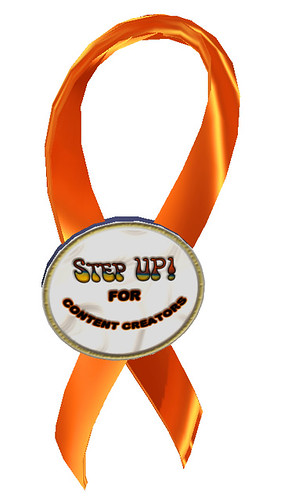
b) As many people as possible wear an orange ribbon as a sign of support for creators. And creators can design these – they can be lapel ribbons, they can be arm bands, they can be tee-shirts … the idea is to make the orange ribbon the theme of the day. And everyone who gets a free orange ribbon gets an information sheet – explaining what content theft is, what they can do about it etc. And they also get an information pack that they can give to their friends (which also contains an orange ribbon for their friends). Why orange? It’s been used before, but has no overwhelming association (unlike pink or red ribbons). It’s a bright, noticeable colour. It suggests explosions and colour …
And it’s an opportunity for stores and content creators to become involved too.
Celebration:
The day ends with parties. Bonfire parties. That means that all around the grid, people have parties. We’re not going to be trying to stage Big Events that maybe only 60 or 70 people can cram into. Instead we encourage every club to hold a Step Up! party. We encourage every musician to play Step UP! events. Everyone on the grid has a part to play. Everyone can take part.
Wednesday, November 4, 2009
ACTA - The Internet Illuminati Planning a New World Order?!

by Cory Doctorow
Secret copyright treaty leaks. It's bad. Very bad.
The internet chapter of the Anti-Counterfeiting Trade Agreement, a secret copyright treaty whose text Obama's administration refused to disclose due to "national security" concerns, has leaked. It's bad. It says:
- * That ISPs have to proactively police copyright on user-contributed material. This means that it will be impossible to run a service like Flickr or YouTube or Blogger, since hiring enough lawyers to ensure that the mountain of material uploaded every second isn't infringing will exceed any hope of profitability.
- * That ISPs have to cut off the Internet access of accused copyright infringers or face liability. This means that your entire family could be denied to the internet -- and hence to civic participation, health information, education, communications, and their means of earning a living -- if one member is accused of copyright infringement, without access to a trial or counsel.
- * That the whole world must adopt US-style "notice-and-takedown" rules that require ISPs to remove any material that is accused -- again, without evidence or trial -- of infringing copyright. This has proved a disaster in the US and other countries, where it provides an easy means of censoring material, just by accusing it of infringing copyright.
- * Mandatory prohibitions on breaking DRM, even if doing so for a lawful purpose (e.g., to make a work available to disabled people; for archival preservation; because you own the copyrighted work that is locked up with DRM)
[FULL ARTICLE HERE]
-----
via Michael Geist
The ACTA Internet Chapter: Putting the Pieces Together
The Anti-Counterfeiting Trade Agreement negotations continue in a few hours as Seoul, Korea plays host to the latest round of talks. The governments have posted the meeting agenda, which unsurprisingly focuses on the issue of Internet enforcement. The United States has drafted the chapter under enormous secrecy, with selected groups granted access under strict non-disclosure agreements and other countries (including Canada) given physical, watermarked copies designed to guard against leaks.
[FULL ARTICLE HERE]
-----
Via EFF.org
Leaked ACTA Internet Provisions: Three Strikes and a Global DMCA
Commentary by Gwen Hinze
Negotiations on the highly controversial Anti-Counterfeiting Trade Agreement start in a few hours in Seoul, South Korea. This week’s closed negotiations will focus on “enforcement in the digital environment.” Negotiators will be discussing the Internet provisions drafted by the US government. No text has been officially released but as Professor Michael Geist and IDG are reporting, leaks have surfaced. The leaks confirm everything that we feared about the secret ACTA negotiations. The Internet provisions have nothing to do with addressing counterfeit products, but are all about imposing a set of copyright industry demands on the global Internet, including obligations on ISPs to adopt Three Strikes Internet disconnection policies, and a global expansion of DMCA-style TPM laws.
[FULL ARTICLE HERE]
-----
Via Huffington Post
Transparency of the Anti-Counterfeiting Trade Agreement (ACTA)
The letter below reports the views of several groups and individuals concerning the lack of transparency of the Anti-Counterfeiting Trade Agreement (ACTA). This is something that is so obvious, it should not require comment, on a policy that is completely indefensible.
The. U.S. and 39 or more countries are negotiating a new global agreement on the enforcement of intellectual property rights, and everything so far is secret from the general public. The main topics are civil and criminal rules, such as injunctions, damages and third party liability from infringements, searches of Internet transactions, border measures affecting the import or export of various consumer goods from medicines to cell phones, and a host of other issues. All 40+ countries in the negotiation have access to the proposed text. And, there are processes for just about any corporate lobbyist with ties to the Administration to see proposed texts, if they sign tough legally binding non-disclosure agreements. So why is it secret from the public?
[FULL ARTICLE HERE]
-----
Via GamePolitics
Letter to Obama Seeks ACTA Transparency
As the 6th round of Anti-Counterfeiting Trade Agreement (ACTA) negotiations get underway in Seoul, Korea, a dispatch has been sent to President Obama expressing concern over the “lack of transparency and openness” surrounding the initiative.
The letter notes that “Unlike nearly all other multilateral and plurilateral discussions about intellectual property norms, the ACTA negotiations have been held in deep secrecy.”
While a curious mix of entities have been allowed to see ACTA documents, after signing a non-disclosure agreement, the letter states that “there were no opportunities for academic experts or the general public to review the documents,” adding that “very few” public interest or consumer groups were included as well.
[FULL ARTICLE HERE]
-----
Via Freakbits
Obama Petitioned to Reveal Secret Anti-Piracy Agreement
ACTA is a mysterious thing that no-one is really certain about. That lack of certainty is because of the lack of transparency around the negotiations. KEI wants that changed, and with an open letter-cum-petition, is calling on President Obama to stand up to his election promises, and make ACTA public.
There has been a lot of controversy over the ACTA treaty. Mostly over the the scope of the treaty (which could see iPod searches at borders for illegally downloaded music) but there has also been a fuss over the way the negotiations have been conducted. Negotiations have been conducted in secret over the past two years, and the Executive Office of the President (Office of t he US Trade Representative) has denied Freedom of Information (FOI) requests earlier this year from FEI, citing Executive Order 12958 – referring to Classified National Security Information. In January, just before the Bush Administration left office, they made similar claims to EFF FOI requests.
[FULL ARTICLE HERE]
Step UP! Call for Live Performers

There will be all sorts of parties across the grid on that day. We think it would be fitting to have Live SL performances featuring performers who sing their own original songs. It will be a great opportunity to make people aware of the wealth of talent and original music in Second Life.
There will also be a party at the Step UP! Headquarters on the Planet Mongo sim fro 2-6pm SLT. http://slurl.com/secondlife/Planet%20Mongo/125/151/30
If you would like to particpate, please contact either myself or Saffia Widdershins.
angie.mornington@gmail.com
saffia.widdershins@gmail.com
*****Please let us know:
1. What time of the day (SL Time) you can perform:
2. What type of music you play:
3: If you can offer your stream of original music that we can give to people who are hosting parties throughout the day:
Thank you so much and we look forward to hearing from you!
For more information on Step UP! SL please visit our blog:
http://stepupsl.wordpress.com/
You are also invited to join our Step UP! Ning Group:
http://step-up-sl.ning.com/
And there is a Step UP! SL inworld group.
angie.mornington@gmail.com
saffia.widdershins@gmail.com
Thursday, October 1, 2009
Is Intel trying to steal Second Life though an expensive advertising campaign?
I don't even know what to make of this; Intel has decided to release a full-on internet advertising campaign sponsoring many websites, which all leads to this video. To me, and everyone else in Second Life, and everyone else using Open Grids (Open-source OpenSim http://opensimulator.com) , and everyone else in the world that hasn't been living under a rock for the past half-decade... um, Intel, we know you're trying to steal Second Life. Calling it Intel's "3D Internet", and obviously ripping off Linden Lab's Second Life, how foolish.
UPDATE: Since this post Intel has conveniently changed the title of the video, changed the description of the video, and has changed all of the information on their Youtube page.
UPDATE: Since this post Intel has conveniently changed the title of the video, changed the description of the video, and has changed all of the information on their Youtube page.
Tuesday, September 29, 2009
Step UP! Make your voice heard about Content Theft

Step UP! Make sure to visit and spread this link -- http://stepupsl.wordpress.com/
Make your voice heard about Content Theft
In the wake of the wholesale theft of sims and content over the weekend, like many people we wanted to do something about it --and also about all the other content theft that we have been fighting for so long -- in the Content Creators Association and in magazines and on TV shows. Th Step Up! campaign is centred on a special day of action that everyone can become involved with, and that can empower and inform people. Step UP! kiosks are now available on XStreet
kiosks available on XStreet.and you should find them at tinyurl.com/ydlpely, or you can search on Step UP! They are, of course, free.
Step UP!
Make your voice heard about Content Theft
The start of Step UP!
2) We need to make people feel empowered by what they do. And, because we are hardly the most time-free people on the grid – we need something that they can largely organize themselves!
So these are our thoughts: We are nominating a day as Step UP! Day – which will be
November 5th – Guy Fawkes Day or Bonfire Night in the UK.
Action:
a) On this day –
no-one uploads textures to the grid.
This should show the economic power of people acting together, without harming content creators. We want Linden Lab to see the power of the feeling about the problem of content theft – and to discuss urgently strategies for tackling it.
b) As many people as possible wear an orange ribbon
as a sign of support for creators. And creators can design these – they can be lapel ribbons, they can be arm bands, they can be tee-shirts … the idea is to make the orange ribbon the theme of the day. And everyone who gets a free orange ribbon gets an information sheet – explaining what content theft is, what they can do about it etc. And they also get an information pack that they can give to their friends (which also contains an orange ribbon for their friends). Why orange? It’s been used before, but has no overwhelming association (unlike pink or red ribbons). It’s a bright, noticeable colour. It suggests explosions and colour …
And it’s an opportunity for stores and content creators to become involved too.
Celebration:
The day ends with parties. Bonfire parties. That means that all around the grid, people have parties. We’re not going to be trying to stage Big Events that maybe only 60 or 70 people can cram into. Instead we encourage every club to hold a Step Up! party. We encourage every musician to play Step UP! events. Everyone on the grid has a part to play. Everyone can take part.
Education:
This is going to come in several forms.
1) Info pack
These will be given out with orange ribbons in stores and at parties.
2) Media
Audio and Visual service ads. The Press. The Blogsphere – everyone can play there part in getting out the message that we have had enoufgh, and we have chosen to Step UP! against content theft.
3) Video
Short informational films – tutorials about content theft.
On the Designing Worlds shows we’ve talked again and again about the need for a social shift – so that people see content theft as socially and morally unacceptable. So … let’s go for it!
Watch this space for more details on how you can become involved, and how you can share with us your plans for Step UP! Day.
The concept originates with a small group – Angie Mornington, Gabrielle Riel, Gwen Carillon and Saffia Widdershins. But more and more people are now becoming involved. And you can too.
Sunday, May 17, 2009
Q and A: The Poor Man's Copyright
Poor Man's Copyright
Q: My friend and I have a bet. I say mailing myself a copy of my songs is a valid copyright. He says it's not. Who's right?
A: Start writing the check; your friend is right, and mailing yourself a copy of your songs is not valid legal protection against copyright infringement.
Although technically a "copyright" takes place the moment the songs are created, mailing your songs to yourself unopened--sometimes called a "poor man's copyright"--provides absolutely no protection in the event of a lawsuit. In fact, according to several entertainment attorneys we spoke with, if you have not registered your copyright with the US Copyright Office, no court will hear your case. So, in order to protect and enforce your copyright if someone tries to steal your songs or sue you for infringement, you must register your songs. In the Court's eyes, if you haven't bothered to register the copyright with the US Copyright Office it's just not worth their time.
Forms and information are available at the Copyright Office. (We especially like Circulars 50 and 56.)
read more | digg story
Q: My friend and I have a bet. I say mailing myself a copy of my songs is a valid copyright. He says it's not. Who's right?
A: Start writing the check; your friend is right, and mailing yourself a copy of your songs is not valid legal protection against copyright infringement.
Although technically a "copyright" takes place the moment the songs are created, mailing your songs to yourself unopened--sometimes called a "poor man's copyright"--provides absolutely no protection in the event of a lawsuit. In fact, according to several entertainment attorneys we spoke with, if you have not registered your copyright with the US Copyright Office, no court will hear your case. So, in order to protect and enforce your copyright if someone tries to steal your songs or sue you for infringement, you must register your songs. In the Court's eyes, if you haven't bothered to register the copyright with the US Copyright Office it's just not worth their time.
Forms and information are available at the Copyright Office. (We especially like Circulars 50 and 56.)
read more | digg story
Subscribe to:
Posts (Atom)