Showing posts with label Performance. Show all posts

Wednesday, June 9, 2010

Second Life's Thriving Music Scene : LA Times

Second Life's Thriving Music Scene
By Laura Ferreiro, Special to the Los Angeles Times

Craig Lyons and other indie artists are leading the charge in the virtual online world. It's a way to earn a living, promote their music, expand their fan base and support causes they believe in.

Craig Lyons

Musician Craig Lyons poses with his avatar from Second Life.

"If I could get some bubbles, I'd be forever indebted," singer Craig Lyons tells the packed house at his Monday night gig. The crowd promptly complies, filling the room with bubbles while Lyons plays his tune "Under Water."

Two nights earlier, the audience made it snow as he strummed the chords to his song "Winter." Strangely enough, the Los Angeles-based singer-songwriter has come to expect this type of supernatural behavior at his shows, which take place several times a week in Second Life, the virtual online world that allows users to interact with one another as avatars.

Despite declining media coverage after a few years of overexposure, Second Life lives on, and within its virtual borders a music scene has been thriving, with independent artists such as Lyons leading the charge. These artists are earning livings, promoting their music and supporting causes they believe in by performing in this virtual space, which has approximately 1 million users each month.

In addition to collecting fees from Second Life venues (there are more than 3,500 known to exist), musicians are often paid handsomely by fans who tip using the Second Life currency, Linden dollars, which is exchangeable for U.S. dollars via a number of websites. Users can buy and sell the currency at a fluctuating exchange rate that usually hovers around 265 Linden dollars to one U.S. dollar.

Lyons typically earns $100 to $200 per show, and he often plays as many as three gigs in one day for audiences logging into Second Life from different time zones. The 3-D virtual world was launched in 2003 by Linden Lab, a company founded by technology guru Philip Rosedale, who was named one of Time magazine's 100 most influential people in the world in 2007. In Linden Lab's alternate universe, people can interact with one another, teleport themselves to exotic virtual locales, buy houses, cars and clothing and amuse themselves with countless forms of virtual entertainment.

Lyons, who has released four albums of introspective pop-rock songs that have appeared on "So You Think You Can Dance," "The Real World" and other shows, believes Second Life provides an ideal platform for artists to broaden their fan bases by reaching people around the globe they wouldn't be able to connect with under normal touring circumstances.

"It feels really nice to reach people who wouldn't be able to see these shows otherwise — be it single parents, physically handicapped people who can't get out of the house, or people who can't afford a $15 cover charge and drinks at the bar," he says. The Ohio native's easy charm and charisma heighten his appeal in this interactive environment, as do his matinee-idol good looks, which incite swooning from several fans.

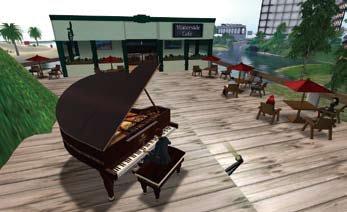
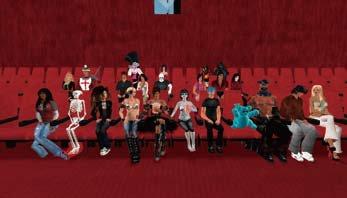
Second Life concertgoers attend gigs as avatars at virtual venues that often resemble "real-life" nightclubs or outdoor amphitheaters. The performances often include live streaming videos from the artists' own studios, while the performers' avatars play on the virtual stage below. During the show, fans mingle and use a local chat feature to applaud, comment on the tunes and even flirt with one another.

It doesn't faze Lyons that the fans filling the rooms are avatars. "Some people are selective about their fan bases. I think that's crazy," he says. "They don't connect the dots and see that they are real people having a real experience." A three-dimensional "widget" on the side of the stage connects fans to Lyons' music on iTunes, as well as his MySpace and Facebook pages — all of which have seen an increase in traffic since he started performing regularly in Second Life.

Helen Harbison, who regularly attends Lyons' virtual gigs, believes the intera
ctive experience that the virtual platform provides can actually surpass that of traditional live gigs. "Gigs in Second Life are a special experience," says Harbison, who lives in Dublin, Ireland. "The interaction between musician and audience makes it special, something that you just don't get at a show in a packed-out venue or bar in real life."

Since Second Life's launch, a handful of major acts, including Duran Duran (Doubledown Edit: Duran Duran never performed in Second Life and press continues to make this error), Suzanne Vega and Ben Folds, have performed or held events in the virtual platform, but none has made a broad impact. "Over the years, Second Life didn't match the hype," says Nelson Gayton, executive director of the Center for Management of Enterprise in Media, Entertainment and Sports at UCLA. "The technology wasn't quite caught up with what people envisioned it to be."

But now, he says, "There's no reason to believe that this isn't a viable platform to experience or promote music. Why not perform in a virtual space instead of going through the challenges of performing in a live space? It's another platform to promote your talent and whatever it is you want to express so people can experience what you have to say."

Missouri indie rockers the Follow, who also perform regularly in Second Life, recognize the convenience these virtual gigs offer fans, and see it as the next logical step in the evolution of social networking. "It's so easy in Second Life — you can teleport your friends immediately, and you don't have to get dolled up," says bassist Amy Rickertsen.

Drummer Mat Matlack adds: "Once people experience Second Life, it will drive people there. The music scene will give them something to do and create an environment for social mixing. It's Facebook on steroids."

Lyons, a self-professed environmentalist, points out another beneficial aspect of this type of virtual gigging. "I legitimately think that it's the most sustainable method of performing for an artist these days, both environmentally — because you can reach the entire globe without burning gas — and financially." Lyons streams most of his Second Life gigs from his Santa Monica home studio using a basic Web cam and a microphone.

He also created an entire music video in Second Life for his ambitious, strings-laden cover of the Beatles' "Across the Universe." The 6-minute video features the avatars of friends, fans and musicians who volunteered their time and talents to create the video.

"Right now, [performing in Second Life] is kind of like the Wild West, but I don't think that will be the case soon," says Lyons. "I think it will be widely accepted and possibly even necessary for any kind of artist in the near future."

calendar@latimes.com


Thursday, April 15, 2010

Beyers and the ReZtones (video) at Metanomics' 100th Episode Bash


ChantalHarvey — Beyers and the ReZtones played live, at Metanomics 100th Episode Bash!
I filmed a very special thank you-song, in which Beyers Sellers sings the names of the people involved in 100 episodes of Metanomics. The gig was held on April 14, 2010, in Muse Isle - which is celebrating it s 4 years party on April 15, 2010.

Robert Bloomfield vocals
Doug Robinson Bass
Brian Earle Clarinet
Al Hartland Drums
Chad Lieberman Piano

Cake , decorations & champagne created by the amazing artist, Tasia Tonic of The Tastery in Second Life™

A special word of thanks to JenZza Misfit.
Film and edit: Chantal Harvey
http://mamachinima.eu

Saturday, April 10, 2010

Muse Isle - 4th Anniversary Festivities - 5 days of Live Music - Sunday April 11th through Thursday April 15th


Historic Muse Isle -  The Legend Continues 


JenzZa Misfit 's - Muse Isle in Second Life™ celebrates 4 years of existence April 11th through the 15th,  with 5 days of LIVE music events & festivities !  On April 15, 2006 - Muse Isle was placed on the Second Life grid and became one of the metaverse's first LIVE music performance venues.  The September 7, 2006 issue of Rollingstone Magazine gave mention to our globally recognized  ' Arena at Muse Isle '.   Join us for the beginning of the future as we honor the past !

Sunday  April 11th - LIVE at The Wild  Rose
SLURL        http://slurl.com/secondlife/Muse%20Isle/60/169/28

7AM PST          Shannon Oherlihy
8AM  PST         Picker Apogee
9AM  PST         Adrienne Deezul

*********

Sunday  April 11th - The Mill
SLURL:    http://slurl.com/secondlife/Muse%20Isle%20NorthWest/204/205/24

5PM   PST-- Von Johin  - Blues -  2 hours

*********

Monday April 12th - Ocean Amphitheater at Muse Isle NorthWest
SLURL:     http://slurl.com/secondlife/Muse%20Isle%20NorthWest/23/215/23

10am PST  -- Duo Appassionato   - Violin Duet - Classical

*********

Monday April 12th - Rock the Arena   -- The Arena at Muse Isle
4 hours  --   5pm - 9pm PST
SLURL:    http://slurl.com/secondlife/Muse%20Isle/166/172/30

5pm -- Andreus Gustafson
6pm -- Dann Numbers
7pm -- Dale Katscher
8pm -- The Follow

*********

Tuesday  April 13th - Guitz & Shiggles at The Mill
4pm - 8pm PST  -- 4 hours of  Eclectic Roots and Blues music
SLURL    http://slurl.com/secondlife/Muse%20Isle%20NorthWest/204/205/24

4pm  PST -- Caoilte Skytower
5pm  PST --  Hazideon Zarco
6pm  PST --   Frets Nirvana
7pm  PST --   kelvinblue Oh

*********

Wednesday  April 14th - LIVE at The Wild Rose
SLURL        http://slurl.com/secondlife/Muse%20Isle/60/169/28

4AM Tommie Scorpio
5AM Hazideon Zarco
6AM TerryLynn Melody
7AM Russell Eponym

*********

Wednesday April 14th   -   The Arena
Metanomics 100th episode party - LIVE broadcast by Treet.TV
SLURL:    http://slurl.com/secondlife/Muse%20Isle/166/172/30

1:30 PM PST  - Beyers and the ReZtones --   LIVE jazz 

*********

Wednesday April 14th - LIVE at The Wild Rose
SLURL        http://slurl.com/secondlife/Muse%20Isle/60/169/28
7PM Dale Katscher
8PM Harper Messmer

*********

Thursday April 15th  -  The Actual Birthday Day - Finale !!
All at The Arena at Muse Isle --  11 AM PST -  8PM PST
SLURL:    http://slurl.com/secondlife/Muse%20Isle/166/172/30

11 AM  - Avatar Quinzet
12 PM -  Picker Apogee
1 PM -   TBD
2 PM -  Russell Eponym
3 PM - MzTere Writer
4 PM - Maximillion Kleene
5 PM - David Csiszer
6 PM - Cypress Rosewood
7 PM - Frogg Marlowe and Jaycatt Nico

Wednesday, February 24, 2010

SL Shakespeare Company Changes Its Name to Metaverse Shakespeare Company

SL Shakespeare Company Changes Its Name to Metaverse Shakespeare Company
by: Lora Constantine

The SL Shakespeare Company (SLSC) today has finalized its name change process, and will now officially be known as The Metaverse Shakespeare Company (MSC).
“In its three years, the SL Shakespeare Company has accomplished its goal of spreading Shakespeare throughout SL via reviving his theatre and architecture on SL, and promoting affiliate events, from discussion groups to Renaissance music to non-SLSC sims,” said Ina Centaur, Artistic Director of the Metaverse Shakespeare Company. “Our new brand name better reflects our expanded mission to take Shakespeare to the metaverse—beyond just Second Life, but also OpenSim, WOW, Entropia, and other multiuser virtual worlds. Moreover, it frees up the general name of ‘SL Shakespeare’ for others to use, to continue to imbue SL with that aqua vitae of Shakespeare.”

READ THE FULL STORY HERE

Website: http://mshakespeare.com
Press Center: http://mshakespeare.com/press
Blog: http://blog.mshakespeare.com
Playbills: http://playbills.mshakespeare.com
Programmes: http://programmes.mshakespeare.com

Monday, December 28, 2009

Ballet Pixelle Performs The Nutcracker - Monday December 28th - 5pm SLT

Monday 12/28 at 5pm - Ballet Pixelle Performs The Nutcracker
Via Chestnut's Choices on New World Notes


Ballet Pixelle performs its version of the Nutcracker for those of you who have not yet seen this seasonal classic. You will be entertained by mysterious dancers on magic carpets, a Russian cossack stamping out a dance, a Chinese Empresses moving about the stage on delicate feet and Spanish senoritas throwing themselves flamboyantly.  In IBM 10.  [SLurl teleport at this link]

----
About:
Ballet Pixelle

Ballet Pixelle produces professional works that creatively enhance the viewer’s experience while attending a ballet performance. Audience members can see classical, neoclassical, contemporary, and novel ballets that cannot be seen elsewhere.  New ballets are premiered with original stories, choreography, and music with dancers from around the world all dancing together in one space.
Ballet Pixelle LogoUnlike other ballet companies, Ballet Pixelle uses new technology to take the art form into a unique environment to new and existing spectators - the first and only of its kind.  The company performs in and takes advantage of a 3D Internet virtual world called Second Life®. The company creatively utilizes unique aspects of the virtual reality, e.g., transforming from human into animal or growing old on stage.  The ballet uses a new breed of dancers and a new classical ballet vocabulary created to take advantage of the innovative medium.  The dancers are virtual representations of human beings (avatars). These avatars, or virtual dancers, are real people from around the globe – Bahrain, Chicago, Denmark, England, Germany, Hawaii, Holland, New York, Seattle, Scotland, and Washington DC – that come together to captivate audiences.  Many are real life professionals.

By performing in an Internet virtual space, it breaks geo-Olmannen
graphical boundaries and time zones, and it allows new spectators to enjoy, in a unique way, a ballet performance that they may have not experienced otherwise. Ballet Pixelle drives further awareness and appreciation for the art form.

“By the end of the first act, I realized that the same emotional response that real life dance can evoke is possible in the virtual realm.”—Pixeleen Mistral of the "Second Life Herald".

Ballet Pixelle’s debut on February 7, 2007, was the world premiere of a new and unique ballet, Olmannen, an original 3-act story written, choreographed, directed and staged in the virtual world of Second Life® at the Ballet Pixelle's Theatre hosted by IBM (IBM 10 (12,191,21).

Friday, December 4, 2009

Police are Now Confiscating DJ Laptops as “Evidence’ for Illegal Parties

Police are Now Confiscating DJ Laptops as “Evidence’ for Illegal Parties-What’s next?
via Davey D of HipHopPolitics & via Joshua Emerson Smith of The San Fransisco Bay Guardian

 
I wanna make sure that every DJ reading this pays close attention and doesn’t dismiss this. Its all about setting legal precedent so police can take things a step further. This is pointed out in the article. 

Every DJ reading this needs to realize that this so-called collection of evidence will eventually start happening when the RIAA and the organizations it backs  (I.e. Music First Coalition, Sound Exchange etc) began tracking down DJs who aren’t paying licensing fees for their music, especially if they are rocking at these ‘underground’ parties. This will really happen if they manage to push John Conyers bill HR 848 and make that into law. 

For those who don’t know, HR 848 is a performance tax they want to charge radio. Play a song on the air and the artist (translation really the label using the artists as fronts) should get some money. This talk about playing songs for promotional purposes has fallen on def ears as far as the labels are concerned. Once this bill passes they will then use this argument of  ’precedent’ and  make the case that since radio is paying a performance license so should deejays and club venues. This argument of ‘precendence‘ is the same scurrilous tactic they are using now to try and pass HR 848, except they are pointing to the highly contested bill that made internet and satellite radio pay similar fees as justification. They are likely to argue that the DJ is making living off the backs of hardworking artists and that there would be no career if it wasn’t for the artist thus an artist should share in a percentage of the revenues.  Keep your eyes open..

Lastly I will remind people if you recall when the RIAA started cracking down on mixtapes being sold in open markets they were able to do something that almost every business I know of has not and can not. They been able to come along with law enforcement on those RAIDS as if they were the police themselves. I also want folks to check to see if some sort of tracking devices or software are not being added to the laptops when they are returned.
-Davey D-

 Controversial tactic of taking laptops even when DJs not charged with crime  reportedly condoned by San Francisco’s new chief of police. EEF attorney steps in to help protect DJs privacy, get computers back.
San Francisco Bay Guardian


Police seize DJs’ laptops
New police chief apparently condones policy that critics call illegal and punitive
By Joshua Emerson Smith
news@sfbg.com
 
San Francisco Police Department officers have added a controversial tactic to their aggressive raids on house parties (see “Fun under siege,” 4/22/09): they’re seizing laptop computers from DJs at the events.

While SFPD officials deny the laptop seizures is a new policy, they admit it has been condoned by Police Chief George Gascón, who took over in August and last month told the Guardian’s editorial board he wants to make the SFPD more transparent and accountable to the public (see “New coach, new approach,” 10/14/09).

“The police chief is aware that officers are being proactive in gathering evidence,” Sgt. Lyn Tomioka told the Guardian when asked about a string of laptop seizures by undercover cops over the last 10 months, most of them in cases in which the DJs weren’t even charged with a crime.
Many of the raids have occurred in SoMa, and were spearheaded by undercover officers who penetrated the parties and were followed by uniformed officers. San Francisco Entertainment Commission member Terrance Alan called the crackdown a “disappointing and dangerous trend.”
Tomioka said it’s a judgment call for officers to seize laptops as evidence of an illegal party, but Alan said the tactic is a punitive measure that proves nothing: “Taking laptops [is] not necessary to prove the underlying crime, and in many cases damages people’s ability to earn a living.”

One of the most recent raids happened on Halloween. It was about 2:30 a.m. and music was pumping out of a warehouse party on Sixth Street. The people throwing the party had hired a doorman, and attendee Eric Dunn was standing in line waiting to get in.

“We were right at the front of the line,” Dunn told the Guardian, when, he said, two plainclothes officers drove up on the sidewalk, jumped out of an unmarked car, and rushed up to the doorman. “[The officers] pretty much started demanding entry right away. The doorman was really polite. He basically told them that you have to know somebody to get into the party.”

Dunn said the officers waited until an exiting guest opened the door from the inside and then made their move. “One guy barged in, and the other guy followed. They never asked permission or received permission to enter the building,” Dunn said.


SF Chief George Gascon is allowing his officers to confiscate laptops from DJs as 'evidence'

Inside, the two undercover officers immediately shut down the event. Justin Miller, a DJ at the event, said she remembers it very clearly. “The cops at that point were telling everybody to leave the party, telling me to turn the music off. I turned the music off. Everyone was quietly leaving.”
But Miller said it didn’t stop there. One of the undercover officers approached her and asked if she had a laptop. She said she did. “I was a little confused at this point because I didn’t know what my laptop had to do with anything. I was playing CDs.” She said she pulled her computer out from underneath a table and unzipped it from a case. The officer then “grabbed it from me.”

The undercover police officer — later identified by witnesses and the evidence receipt as Larry Bertrand — instructed Miller to follow him down to the street to get a property receipt for her laptop.
At this point there were uniformed officers on the scene as well. Miller started to cry. “I begged him. I said, ‘This is my livelihood. You’re talking my laptop. This is my livelihood. I hope you realize that.’ He said, ‘This is how you’re going to learn then, I guess.’”

Miller said Bertrand (who did not return Guardian calls for comment) then told her he was “going to take it upon himself to shut down every illegal party in San Francisco.”

She said he then opened the trunk of his car, revealing several other laptops. A person at the party pointed out that one of the laptops belonged to a friend of his, and asked if he could get the property receipt for the laptop. Miller said Bertrand turned to the inquiring person and said, “You will never see this laptop again.”

She continued: “He then looked at me and said, ‘I’m going to make sure your paperwork gets so tied up that maybe you won’t see this laptop until December, January, February, who knows when.’ I felt so violated.”

Miller has been working as a DJ in the Bay Area, under the name DJ Justincredible, for more than 10 years. She says she’s never had any of her equipment confiscated by the police before. But at that party, three DJs had their laptops confiscated, even though none were charged with a crime.

Shortly after the Halloween incident, Miller and the two other DJs who were at the party contacted the Electronic Frontier Foundation, a nonprofit advocacy group specializing in technology and privacy issues. Jennifer Granick, a civil liberties lawyer with EFF, said most people haven’t heard about this because few of these DJs, if any, ever get convicted of a crime.

“DJs and the police department know that sound equipment and laptops are being unlawfully seized. But the public and the courts haven’t heard much about it because every time a DJ asks for a hearing, the cops just give them their property back rather than show up and defend the practice in open court before a judge,” she said.

Sean Evans has been working as a DJ in San Francisco, under the name DJ 7, for more than 10 years. He said that over the summer he had his laptop seized by police during an after-hours party in SoMa. He was given no property receipt, and his case was dismissed. But it took him three months to get his computer back.

“To lose our sole means of income, it’s a huge setback. It puts us out of work. In this recession, we’re struggling, and we need our laptops to get by,” he said. Evans grew up in the Bay Area and he said has never had anything like this happen to him before.

Granick argued it is illegal for police to seize property without issuing citations or arrests. She also said there are serious privacy issues at stake. “If we were to find out that the police were doing something else with the laptops, like searching through them or copying the data, we would definitely go to court,” she said.

SFPD Sgt. Wilfred Williams said he could not say what was currently being done with the laptops. In general, he said, private events that emit “extraordinary amounts of sound” need permits. And if they don’t have the proper permits, he said, property can be seized as evidence, “be it the speakers, be it the laptops, be it a mixer.”

Both Tomioka and Williams say the seizures aren’t a new policy. “If you look back in time, laptops haven’t been used for music,” Williams said. “There used to be old types of equipment that was taken in the past. But now laptops are being used. So yes, today, laptops [are] being seized.”

Entertainment advocates have called on Mayor Gavin Newsom and Gascón to come forward with an explicit policy concerning these raids and seizures. The Mayor’s Office did not respond to Guardian inquiries. Critics of the policy say it’s having a chilling effect on nightlife in San Francisco.

Wednesday, November 4, 2009

Step UP! Call for Live Performers


On Thursday November 5th Step UP! SL will have an all day grid wide celebration to show solidarity & support for content creators in Second Life.

There will be all sorts of parties across the grid on that day. We think it would be fitting to have Live SL performances featuring performers who sing their own original songs. It will be a great opportunity to make people aware of the wealth of talent and original music in Second Life.

There will also be a party at the Step UP! Headquarters on the Planet Mongo sim fro 2-6pm SLT. http://slurl.com/secondlife/Planet%20Mongo/125/151/30

If you would like to particpate, please contact either myself or Saffia Widdershins.
angie.mornington@gmail.com
saffia.widdershins@gmail.com

*****Please let us know:

1. What time of the day (SL Time) you can perform:

2. What type of music you play:

3: If you can offer your stream of original music that we can give to people who are hosting parties throughout the day:

Thank you so much and we look forward to hearing from you!

For more information on Step UP! SL please visit our blog:
http://stepupsl.wordpress.com/

You are also invited to join our Step UP! Ning Group:
http://step-up-sl.ning.com/

And there is a Step UP! SL inworld group.

angie.mornington@gmail.com
saffia.widdershins@gmail.com

Monday, October 5, 2009

Doubledown Tandino - Available to DJ, Emcee, & Promote your Halloween Event


Hello ghouls, goblins, and ... avatars.  I (Doubledown Tandino) am available for Second Life Halloween bookings and events.  Halloween is my favorite time of year, and I cannot wait to perform at some of this year's inworld parties.

I am a professional real life and Second Life DJ, and do a live turntable mix of current modern spooky electronica (house and breakbeats), combined with live remixing of various classic Halloween jams.  I've done Halloween events for over a decade, yet always find ways to make the music fresh and unique each year.

Booking me means you'll get:
- Advanced promotion of the event; includes inworld marketing + internet & social media based.
- During event promotion; includes TPs, notices, group chat, twitter, facebook, status updates, etc.
- Live broadcast DJing & live mixing and remixing
- Live on-the-mic Emcee to promote goals of the event (products, freebies, giveaways, contests, venue info, people involved info, etc)
- The broadcast stream (if your venue does not have one)
- Any extra Halloween decorations if needed (I am able to provide a Halloween DJ booth & lighting)

October 28th, 29th, 30th, and 31st dates are available (pending time availability.)
Depending on your expectations, approximate rate is $5000L for one hour, $8000L for two hours.
(The time spent on advance promotion is included.  (If you would like a graphic flier designed for your event, the cost is $5000L.))
The cost is $3000L per hour if you JUST would like me to DJ, but not do any promotions or speak on the mic.

please contact me ASAP at DJDoubledown @ gmail.com to discuss your expectations and lock in the time.

Thursday, September 24, 2009

Learning How To Play Guitar... well enough to get you laid


Comment here if you've heard this kind performance live in Second Life.... oh, I dunno, a thousand times.

/sarcasm
This type of live Second Life music show DEFINITELY needs a cover charge.
/end sarcasm

Monday, September 21, 2009

The New Pioneer CDJ-2000 (video)


My mouth is watering. It's the newly released Pioneer CDJ-2000. This is the ultimate DJ turntable capable of doing, well, every single thing a DJ needs to do, whether they are spinning in the club, at home, using Ableton Live, Serato, Tracktor, broadcasting over the internet, or performing into virtual worlds such as Second Life.  The video below explains the capabilities.

Tuesday, September 15, 2009

Feline Slade's Perspective from the Audience Member's Viewpoint

Slamming Shut the Door on the “Killer App”
by Feline Slade
via http://felineslade.wordpress.com

"M Linden’s now-infamous labeling of music as a “killer app” for Second Life has led to a lot of discussion and blowing of hot air. Even when some very specific and relatively easily-implementable suggestions were made during the Looking to the Future of Live Performance in Second Life session at SLCC (Really, how hard would it be to repurpose an unused subcategory in Events?), they were automatically put in the “Not in 2009″ pile. In the end, the live music community has been left to its own devices to feel its way along.

I’m pretty much a nobody on the Second Life live music scene. I don’t own a venue. I am not a musician, since I can’t tolerably play an instrument as well as sing. So why is the current music venue “to cover charge or not to cover charge” drama bothering me? Maybe it’s because I’m the supposedly deep pockets that it feels like some music venue owners and musicians seem to want to reach into for cover charges.
So in the interest of market research, let’s take a look at a few facts about Feline, a representative individual among SL Live Music Target Market... "

READ THE FULL STORY HERE:
Slamming Shut the Door on the “Killer App”

Monday, September 14, 2009

Zak Claxton's Thoughts on Music Venue Cover Charges in Second Life

Zak weighs in on Second Life Cover Charges
by Zak Claxton: via http://zakclaxton.blogspot.com


"Since everybody and their respective monkeys have offered an opinion on the proposals to standardize cover charges at Second Life live music shows, I felt a need to add my L$10 to the fray. Don't worry; I don't think you'll find anything particularly inflammatory or controversial here. Just a few thoughts on the topic. First, the background.

Flame On!
Late last month, the Second Life Newspaper ran an article on a cover charge system that was brought up by a fellow SL musician, Mankind Tracer. Note that I said "brought up"; he's hardly the first person to suggest this plan, nor the first to implement it. But he seems to be the focus of the controversy for current go-round of the idea that SL audiences should pay a cover charge to see live music events, as opposed to relying on people's desire to tip artists and venues on their own accord.

Why is this even being considered?
Pretty simple answer to a complex situation: it's getting harder and harder for venues to pay performing musicians. Many venues that formerly offered a fee to musicians found themselves unable to do so for various reasons, and one of two things happened; they either closed their stages, or they convinced the musicians that performing for tips only was in the best interest of everyone. So today, the majority of places you go to see live music in SL do NOT pay their musicians (but some still do... more on that in a bit).

So, according to the article, Mankind Tracer's plan would have a preset entry fee, enforced by a "bouncer bot" that would eject non-paying residents from shows. He initially suggested a ticket price of L$500 (about two US dollars, for those of you unfamiliar with SL's in-world currency) for an artist of his caliber, from which a 20% portion of the total take would go to the venue. Sounds pretty good on paper, at least for the artist and the venue, right? Let's say Mankind gets 30 people to come to the show at L$500 a pop. The evening grosses L$15,000, the venue takes $3,000, and everybody is happy, right?

Nope.
Here's why this system is not going to work for most artists, venues, and (most importantly) audiences in SL live music. In no particular order... "

READ THE FULL STORY HERE: 
Zak weighs in on Second Life Cover Charges

Saturday, August 1, 2009

We Need Your Help to Improve Live Performance in SL!

Via inSL note:

Live performance is Second Life is one of my passions, and if you are reading this notecard it's probably important to you too. And that's why we need your help.

Linden Lab has asked the live performance community for our suggestions, ideas, complaints and genius bits about how to improve the overall experience for everyone - from performers to venue owners and event planners to residents.

As part of the SLCC Music Track, we will be having a discussion
Saturday at 3PM SL/PDT
on the panel: Looking to the Future of Live Performance in SL with Colossus Linden.

You can help make that track powerfully meaningful- just add your ideas and insights using the embedded form found here:
http://bit.ly/SLCCideas

Everyone's input will be collected, we'll organize the information, and we'll talk about as much as we possibly can at SLCC. We'll also make sure that the information is accessible to anyone that is interested.

Please spread the word and thanks in advance.

If you have questions, just drop me a note.

Peace ~ Grace Mcdunnough

Saturday, June 13, 2009

The Music Industry -- Real Music for a Virtual World - J@pan Inc Magazine

The Music Industry -- Real Music for a Virtual World
By Jean-Julien Aucouturier of J@pan Inc Magazine

The virtual landscape of Second Life (SL).

The virtual landscape of Second Life (SL).

By Jean-Julien Aucouturier

With nearly 1.5 million members, could concerts in Second Life be the future of music?

The two artists, both professional musicians, couldn’t be more different.

One is a live-show powerhouse, playing more than 20 sell-out gigs per month. His fans travel from all over the world just to see him, and many have been following him since the early days. In between concerts, they blog about the shows. During the concerts, they tip so fervently that money literally piles up on the stage.

The other is not reaching the audience he deserves. Embroiled in a disproportionate network of industrial interests, his artistic freedom is jeopardized and his music denied radio airplay. His tour manager is fixing abusive ticket prices, which are beyond his control. His current contract rips off more than 70 percent of his potential revenue. Like many of his fellow artists in the same scene, he is incredibly tempted to simply give his music away for free, craving for a way to just reach his audience without all the hassle.

Musicians can reach people they wouldn’t have been able to previously.

Musicians can reach people they wouldn’t have been able to previously.

The second of these two musicians is the recipient of 19 Grammy Awards, Bruce “The Boss” Springsteen. The first is Komuso Tokugawa, a robot-like 3D avatar who sings the blues in the virtual world of Second Life. Many will resent comparing the author of “Born In The USA” with what is essentially a creature of pixels and bytes. Introduced in 2003 by California-based Linden Labs Inc., Second Life (SL) is a computer-based recreation of the real-world, entirely built by its users—now a thriving community of over 1,400,000 people. Like in a video game, real-life users of SL appear in virtual reality as 3D characters—or avatars—and they can interact with other users’ avatars and their environment. Certainly, there is an irreducible difference between singing in front of the 98.7 million viewers of Super Bowl XLIII, and singing into one’s computer to a virtual audience of a few tens of 3D characters. But the question here is not whether virtual worlds like SL offer conditions for music that are better or worse than, say, the radio or the mp3 before them. The key question is whether the emerging micro-economy of music in SL is a fad or a trend, something so strong maybe as to shape the future of the music industry. Something that technology will have to follow, rather than create.

Playing one’s own music for a virtual audience doesn’t require a lot of technical know-how. With a microphone and an audio interface, one can capture sound live in a computer at home or in a studio, and set up this computer as an internet radio server to broadcast the audio stream to the computers of your audience. If at the same time, the performer is present in virtual reality as his/her avatar, and the audience is too, you’ll get a complete virtual recreation of a gig. This relative simplicity explains in part the formidable popularity of live music events organized in SL. A survey in September 2007 showed that 58 percent of the events advertised on a typical SL day are live concerts and another 38 percent are DJ/Club events.

Interestingly, music in SL is nearly never recorded music; what matters is the live performance. In a sense, this jumpstarts a trend that the real-world recording industry has been resisting for years now: its, well, death.

Interestingly, music in SL is nearly never recorded music; what matters is the live performance. In a sense, this jumpstarts a trend that the real-world recording industry has been resisting for years now: its, well, death. According to the Recording Industry Association of America (RIAA) CD shipments in the United States were down 20 percent in 2006, and again down 17.5 percent in 2007—something the RIAA readily attributes to illegal file-sharing on the Internet, but academic research rather identifies as the end of an age. What is under question here is the very value of fixing music on a medium. Leonie Smith, a jazz singer in real-world and a SL TV host by the name of Paisley Beebe, puts it in a deceptively simple way: “In the real world, you might never get to see your favorite musician live. This is why you buy CDs. In SL however, you can teleport out anytime if you want to catch that musician maybe once a week, maybe eight times a week.” If seeing a given artist live becomes a commodity, who needs to acquire a recording? Many real-world musicians have stepped in this direction already: Trent Reznor and his band Nine Inch Nails made the news recently for sharing with their fans more than 400 Gigabytes of unedited, raw concert videos in HD format via their Website. What SL brings beyond this is that in the same time it takes to play an iPod, one can actually be in the concert and experience it as part of the crowd.

The new face of an audience for artists?

The new face of an audience for artists?

If you’re like me, you’ll probably feel skeptical at this point. Experiencing a virtual concert conjures up visions of uninspiring 3D polygons, awkward navigation with a mouse and keyboard and avatars mistakenly rendered half-way through a pillar or a wall. All of this is true. But what is also true is that, despite all the glitches, the feeling of being there is absolutely astonishing. Watching a concert with your screen flushed with a constant flow of text comments from the audience, hearing the sound of clapping and fans calling out to the band with their real voice (if it works for Skype, it does here too) as well as seeing the performer obviously reacting to all this, addressing people by their names, taking song requests—all this leaves one wondering if there is actually anything missing from the real-life experience of music. Technology is constantly improving, and we will soon be able to teleport at will in the middle of an ongoing music video of perfect HD quality. Already, in June 2008, hit UK pop star Kirsty Hawkshaw had the video of her song “Hypoheretic” shot in a virtual world, in “real-time 3D.”

The experience is good for the artist too, it seems. Doubledown Tandino, a well-known DJ in SL, says it’s even better than the real thing “because all the people that are listening love what they’re hearing— else they’d just step out and teleport to the place that does have the DJ they want to hear. The crowd is always much more appreciative and respectful than in RL [Real Life].” How about the audience lacking body language and real-life responses? “It’s replaced by a different sort of energy. It’s about the shared musical experience, blasting the tunes and being locked in great conversation that fills up the night with a great experience for everyone. There is a way to read a virtual crowd by the way it texts or tips.”

An example of an SL venue.

An example of an SL venue.

And that is the crux: connecting with the fans creates revenue. SL has its own currency, the Linden dollar $L, and it has an exchange rate with the U.S. Dollar. In other words, the money one makes in SL is real money. In our study of the 57 Djs in the SL Club Vortex, we found that most people tip at least 50$L per DJ set, with an average of 100$L (c. 100 yen). The average tip jar earned per set by a DJ is 1000$L (c. 1000 yen), with peaks at 5000$L (c. 5000 yen). These amounts are smaller than their real-life equivalent, but then nothing prevents you from playing tens of performances every month, as potential venues are just one “teleport” away. “Performing virtually has a number of advantages over RL,” says Paul Cohen, the Tokyo-based brain behind Komuso Tokugawa the BluesBorg, “instant setup, no travel from home studio to gig, and less wear and tear on gear.” Over the past 3 years, Paul/Komuso has played over 800 concerts in SL, topping at more than 40 a month. Even with only a few tens of dedicated fans at each concert who are ready to tip (about 60-70 percent of my gig audiences are regulars), this is clearly not a bad business to get into—one that is reminiscent of Kevin Kelly’s vision of an independent artist needing only 1,000 “true fans” (that will buy anything he/she produces) to reach sustainability.

All this SL activity is starting to reach out too. Real-life companies increasingly hire SL musicians to advertise their brand into the virtual world (for instance, DJ Tandino was contracted by Playboy in 2007). The recording industry itself is said to scout SL for new talents. In August 2008, SL bluesman Von Johin signed what is believed to be the first record deal offered to an avatar, with the independent label Reality Entertainment. Not surprising, says Sho Iwase, music industry expert in Gerson Lehrman Group. “Japan has many examples of artists receiving massive The majority of the money made is made from live performances.

While record stores exist, the majority of the money made in the virtual music industry is made from live performances.

popularity online through websites like Niko Niko Douga [the Japanese YouTube] and eventually managing to earn themselves a record label contract. Rapbit and Kurikinton Fox are two prime examples.” You start by uploading a video of yourself rapping to an anime theme song and you end up signed to EMI. The transition might be difficult, though, warns Iwase: “Virtual music fans like the musician because he/she is unknown and is “close” to them. Once he/she becomes popular, fans no longer feel needed and tend to move on.” Von Johin’s weekly concerts in SL remain free for now, but his debut album is planned to reach iTunes and Amazon at the end of this year and some compromises may be needed on the way.

This shows that eventually virtual worlds like SL cannot stand alone as a replacement for the current system. “It’s just a tool, and I’m just connecting worlds,” says Paul Cohen/ Komuso Tokugawa. But in the process, blues-singing robots like Komuso are also showing that there are still ways to make a living doing just what music should be about: playing and getting heard. And this is good news, especially for Bruce Springsteen. JI

-

JJ Aucouturier is an assistant professor of Computer Science at Temple University, Japan Campus. He is an expert in audio technology and artificial intelligence, with a background in the music industry. More on jj-aucouturier.info

The article above came from HERE

http://www.japaninc.com/mgz86/real-music-for-virtual-world

------


Friday, June 12, 2009

Why Bands Should Avoid the Myth of the Rockstar

Why Bands Should Avoid the Myth of the Rockstar
by Nick Fitzsimons from Penny Distribution

Nick Fitzsimons founded Penny Distribution in 2007. Originally a physical and digital distributor, Penny has since evolved to include booking, promotion and marketing services for its artists and labels. Nick also helped organize UnConvention Belfast and the NI Music Industry Meetup
series.

Peers, Friends & Fans

It’s one of the most memorable scenes from “This Is Spinal Tap” and marvelously summed up the prima donna cock-rock superstar. Tap’s guitar player, Nigel Tuffnell, draws his managers attention to the buffet plate back stage, complaining about the size of the bread, and that he can’t make a sandwich with tiny bread – “It’s a disaster!” he squeals like a 5-year-old.

Rightly or wrongly, the mythos exists that being in a “successful” band means being waited on hand and foot, being lord over all you survey (labels, partners, peers and fans) and that hissy-fits and difficult behavior can be excused because you’re an “artist” – some would even say that being difficult is a pre-requisite of being a true artist.

The truth is that working in music is essential working with people. Despite the appearance that a musician has single-handedly conquered his particular domain, there is a subtle and intricate network, usually numbering into the hundreds of people, who’ve all played their part in propping up this particular house of cards.

If you operate under the assumption that success in this industry can be achieved by you alone, you’ll probably last as long as one of Spinal Tap’s drummers.

And this applies to music businesses, too. Working as a label or promoter is such intensive work that it can be far too easy to become absorbed with your work, never looking up or taking time to see if there’re other businesses or individuals involved in similar or possibly complimentary activities.

With that in mind, I think we can divide the types of people that really matter into 3 groups.

Peers:

These include artists, songwriters and other music businesses. The myth exists most strongly here – other businesses are the “competition”. (for the sake of this piece I’ll call all artists & music enterprises “businesses”). They might steal your ideas.

In today’s music business, I think we need to blow this thought out of the water. Ideas are so numerous people are giving them away. Whatever the idea, it’s the execution, not the idea , that matters most.

Not only that but interaction with other businesses is begun in the spirit of co-operation with the goal of mutual benefit or the achievement of common goals.

Of course you need to work with people you trust, with companies who share your outlook and ethos – but pulling down your shutters to the outside world because the chance exists that things may not turn out well is a sure path to failure.

Get out to networking events or start your own. Anything that gets your peers into a room together, talking to as many people as possible is of benefit. That was a main motivating factor behind UnConvention Belfast (and, I believe, Un-Convention in general) as well as the now-monthly Northern Ireland Music Industry Meetups in Belfast that followed on from UnConvention.

It’s not a question of competition or stealing ideas. It’s simply a question of optimism (think of what we could achieve together!) versus pessimism (they’ll abuse my trust and betray me somehow). Where do you stand?

Friends:

These include bloggers, interviewers or radio – anyone who, for whatever reason, is interested in your music and is taking the time to talk to you about it.

Research the company behind the interview, find out who listens or comments on the content but above all else be enthusiastic.

I’ve heard so many stories from people in radio where the rock ‘n’roll ethos is so prevalent (among established and emerging acts alike) that the band or songwriter treats the interviewer with indifference, or worse, with “don’t-you-know-who-I-am?”-style contempt.

The truth is, no matter how successful you are, every person you interact with as a business has the potential to change the game for you and your endeavors. The problem is that there’s no way to tell who that’ll be – by acting like a Rockstar you’re basically destroying any chance that one of these people will help you in the future.

Fans:

I’ve talked quite a bit about how to treat your fans, but the basic tenet to understand is that they have as much control over your success as any writer from Pitchfork or WOXY.

The amount of times I’ve seen bands treat their audiences with contempt is beyond count and, although disasters like Wavve’s recent meltdown in front of an audience of potential fans at Primavera are rare, there’re plenty of other missed opportunities.

Most bands will say “thanks for listening” after a show, but are they really thankful? If they are, how are they showing it? How about writing an email the day AFTER the show to thank attendees, including a demo of the new track you just wrote? Or making sure fans leave with some music as a tangible “thank you”?

The goal in all of this is that the next time you’re working on a new business idea / have a tour to promote / playing a show in someone’s town, you’ve earned the loyalty of people you interacted with the last time you were there.

Do you think you’ll have that loyalty if you run step-by-step through the Rockstar playbook?

I’d say if you toss aside the Rockstar shit, if you act with genuine enthusiasm, humility and with a sincere recognition that it’s a privilege to work in music, you’re much more likely to have that loyalty.

DIGG IT

(Doubledown Note: I found this article to be spot-on, quite interesting, especially because I think it completely holds true in Second Life and virtual worlds as well as the real world.)

Tuesday, June 2, 2009

Second Life Music can Equal Success and Profit - Part 1: Possible Goals

Second Life Music can Equal Success and Profit - Part 1: Possible Goals

The virtual world of Second Life allows for a collaboration of people to come together to create a real-time live music event. In SL, there's a vast range of music performances. The measure of success is completely relative to the people involved. Everyone's goals are different, while many goals are similar and will overlap each other. Some performers are content with simply playing inworld to people across the globe. Some venues are simply content as being a land space for a live music event to occur. Meanwhile, some performers & venues have complex productions most everyday of the week, booking SL talent nonstop, and utilizing multiple event staff.

In part 1 (of my 3 part series): "Second Life Music can Equal Success and Profit", I want to discuss the possible goals surrounding a live music event in Second Life. (Part 2 will organize the roles of each person involved in a successful and profitable live music production. Part 3 will discuss possible avenues and approaches to making more profit from an inworld music event.)

I want to begin by discussing ways an individual performer and an individual venue can come together with their plans and agendas in order to generate a money flow. It IS possible, especially because the effort and passion is usually already present.

Possible Goals of a Live music event:

* To perform (obviously) - This goal is accomplished when the performer can perform a show and has performed a show. The performer gains experience & practice - This 1st goal, of course, the easiest to reach. When the performer is performing the show is happening.

* To express yourself / To stay true to yourself - This is the artistic & talent side to the show. Fortunately for Second Life, the music performing artist isn't the only artist in the room. In fact, it was an artist that built and designed the room. I even view the team involved in a venue as being artists. The goal of self-expression in SL; It is what it's all about. Anyone that does anything in SL is fortunate to meet their goal of self-expression. It's impossible not to. For performers and venues, staying true to oneself is usually what it's all about too.

* To create the ability for a performer to play music to people - For the performer & the venue, when this goal is reached, exposure & audience is present. Slightly different than the performer simply performing, this is about creating a fan base for the performer, the venue, and the team involved. Any person that arrives to a show has already been exposed just for arriving, and now is a potential (something); potentially a word spreader, tipper, investor, shopper, CD buyer, talent booker, etc. The reason someone arrives to a music show is usually, 'said live performer is performing'... however those reasons can be revised once they arrive.

* To create a family, crew, team effort relationship around the owners and staff of the venue - This is a very important goal to most venues, and also to the performers choosing which venues they perform at. Many successful venues inworld stay successful, with their doors open, when the love and passion from all people involved is there. Especially when profit is NOT a goal, creating the family/friends vibe for a venue usually becomes an important goal.

* To create a popular venue with a unified team. This continues beyond "building the team effort" which I mentioned above. This goal is about presenting and perpetuating the reputation to the public. When the performer is booked, this is where the venue, performer, & team involved, needs to either capitalize, or just sit back and enjoy the show they've produced. Many venue owners and staff do it for the love of it... and that's a goal too. Meanwhile, booking the performer in the venue and having the show actually happen, sometimes is only the beginning, not the satisfying end result. Venues (the management, staff, performers) need to keep in mind: what are the real goals in bringing all these people to the venue other than to listen to the performer. Is it to add fans to a group, is it to sell products in a nearby vendor, is it to perpetuate the club's popularity by announcing future shows?

* To create something unique, revolutionary, ahead of it's time, and beyond the norm - After a venue or a performer has settled into their routine of SL performances, sometimes they want to explore new creative options of entertainment or stimulus and revolutionize their standards. Examples of this could be lining up a full day of performers for a festival, themed events, or basically just adding anything unique into the show. Also, many locations inworld aren't build to be a music venue (such as an art gallery, or a sim opening event). In their own way, these locations are creating something unique simply by having a live performance.

--- ----
Above I listed one set of goals, more aimed at fun & enjoyment plus exposure as being the high standards. Below I list the goals involving monetization. The goals below; not for everyone. Many sway into differences of optinion, and some choose not even to make money or profit part of the equation.

* To create traffic - This is the goal of having avatars at an event and to create traffic. I don't mean the land traffic calculation number, I mean the general flow of people in and out, the traffic. For example, think of a website... it gets on average 100 people to visit the website a day. That is the traffic. It doesn't mean the people that visited were quality, or even read the webpage, but it does mean people were there and pageviews happened. With some venues and performers, their main goal is simply "the traffic." A large crowd is obviously better than a small one and gaining/maintaining the traffic seems to play a large role for some. The goal of traffic is also a great way to combine all walks of life into one music event. Usually a traffic-aimed event is filled with not only music fans there to see the show, but also newbs, randoms, and the nonmusic public in SL.

* To make money as the performer, venue and staff - The profitability is a goal for some. Usually more often, we hear the venues are in need of making profit, because plain and simple: making profit above the cost of land, rent, bills, payroll is the business plan... or more like the business dream. It seems that when people start a club in SL, they either set out from the get-go and declare they are not in it for the money... or... they start the club, and soon find out just paying club expenses isn't making them money, and instead it's going to render them bankrupt. Some venues choose to disregard making money and I applaud the efforts. The same goes for performers. Some performers in SL do not let making money factor into their SL music hobby. Meanwhile, performers and venues, many have the goal of profit. It's a dance, finding ways to be profitable without selling out or feeling compromised. In part 2 of my SL music: success and profit series, I will delve more into the profitability goal.

* To create profitability by sales. Some venues choose to have sales intermingled with their venues, either as a shopping area attachment, or some selected items on display near the dance area. Some venues charge admission. Some performances and events charge a cover as well. Performers have the ability to display music for sale at each of their shows. All of these aspects can be a reason for any event.

* To create an avenue for sponsorship. Advertisers and sponsors need to get their word out. A public venue or a performer (in RL and SL) is a great way to get that word out. A goal can be to gain a sponsorship business relationship in order to offset costs. By doing events, the sponsors receive their promised agreements (business relationship reputation)

If you're a venue, what are your club's current goals? Is it to keep booking performers? Is it to stay packed? Stay popular? Is it to build a large following for the club? Is it a place for performers and community to simply jam? Is it a mutlicomplex that offers more than a music location?

If you're a performer, what are your current goals? Is it to perform as much as possible? Is it to sell your music? Is it to hit people with your sounds around the world? Is it to become popular in real life? Is it to make money? Is performing in SL a way to continue practicing?

If you're a venue manager or staff member, what are your current goals? Is it to perpetuate the passionate support of the venue and crew? Is it to help make the club money? Is it to simply have a job in SL?

If you're a performer manager or booking agent, what are your current goals? Is it to book as many of your performers as possible? Is it to build a strong relationship with several performers and help build their career? Is it for the money and the commissions? Is it for the noteriety?

PLEASE let me know more in comments and I'll add here in updates. I'm looking to somehow conform this into a group made article, so please, use comments, let me know any thoughts, and I will work them in on revisions with credit.

Doubledown Tandino

Tuesday, April 7, 2009

Artists visit virtual Second Life for real-world cash | CNN


Artists visit virtual Second Life for real-world cash
By John D. Sutter | CNN

It's 9 a.m. when Cylindrian Rutabaga takes the microphone at a familiar bar.

The funny-named musician with crinkled red hair, a white blouse and flowing skirt picks up her custom-made guitar and looks across the audience with a blank stare.

Her fans already are rocking out: Some breakdance on the bar's tile floor. Others flail about with the vigor of '70s disco dancers. One man with a towering afro and 3-D glasses looks like he's swimming the backstroke to some nonexistent beat. Read full article »

digg story

Sunday, April 5, 2009

ROLE Magazine April 2009 Issue of Out Now

ROLE Magazine is pleased to announce the publication of our April, 2009 issue. This month’s cover story addresses the announcement by Linden Lab that adult content will be relocated to a new continent named Ursula.

This publication includes an exploration of the steampunk artistry of Bryn Oh, a visit to the extensive Caledon library and the mysterious sim INSILICO, the auditory delights of live looping and look at the options offered by resident-created alternate SL client viewers. April’s fashion section holds a colorful and artistic spread showcasing the latest spring-time trends; hot finds and kawaii; fashion tips for men from the woman’s perspective and fresh, spring styles for men and women. ROLE Magazine blog posts can now be shared by linking directly to your Plurk or Twitter page.

Last, but not least, we announce the start of the ROLE Magazine Complete Wedding Package Contest valued at $L30,000! See our new April issue for details and enter today.

read more | digg story

Doubledown Note: Check out the article on performing live loop-based music in Second Life on page 52. Also a great article on Steampunk art on page 56.

Tuesday, November 11, 2008

The SL Shakespeare Company Returns to Shakespeare with "Twelfth Night"

The SL Shakespeare Company Returns
with Shakespeare's "Twelfth Night"

The SL Shakespeare Company (SLSC) will perform a full ensemble performance of Shakespeare's Twelfth Night: Act 1 in a special short-run advance mini season as part of their Fall Season 2008 repertoire.

Opening on SLSC Thursday, November 13th (following a "sneak peek" on November 12th), the full-length Act 1 is the first part of the culmination of a summer's worth of rehearsal-performances in SLSC's tag-team staged reading series of Twelfth Night.

Maintaining their tradition of visual and theatrical extravagance, the mini production also introduces the usage of multiple rotating sets, incognito animation preloading, global lighting and weather control to SLSC stagecraft technologies. Live dynamic camera control by a director fine tunes the performance with a cinematic appeal, while international subtitles, the SLSC's "Pay as you Will" philosophy, and the play's location in the confluence of four island simulators of the SL Globe Theatre make the performance accessible to as many as possible.

Directed by Ina Centaur and Voice Directed by Enniv Zarf, the production stars MadameThespian Underhill, Joff Fassnacht, Prospero Frobozz, Ludo Merit, Maedin Tureaud, and Lorne Harlequin, and also a motley cast of "silent actors" who create a different variation of a background crowd each time.

Mini Season schedule (All times SLT or GMT-8):
Wednesday, Nov 12 - 11 am "sneak peek"
Thursday, Nov 13 - high noon
Friday, Nov 14 - 1 PM
Saturday, Nov 15 - 2 pm - (ticketed)*
Sunday - no show
Monday, Nov 17 - high noon
Most of our shows at the SL Globe Theatre are free, but VIP/ticketed shows
charge a nominal admissions fee of L$500. The smaller audience may entice.