Showing posts with label Music Industry. Show all posts

Tuesday, July 27, 2010

Twitter DJ for Traktor Pro by M_nus Records


What if every underground artist had a way to see what DJs are playing their tracks in the clubs? What if they could not only see who’s playing their tracks, but could see what time the DJ played their track, what country, and even got a message the minute their track was dropped in the club? And even better, what if the artist could actually get PAID for their track getting played? Thanks to a new technology called Twitter DJ this is all possible now.

READ THE FULL ARTICLE HERE

Monday, June 7, 2010

Selling Out: How Much to Music Artists Earn Online (Infograph)

Selling Out: How Much to Music Artists Earn Online (Infograph)
Click to view full size

Monday, January 4, 2010

All the Rules of the Music Business Have Changed - A World of Megabeats and Megabytes (NYTimes)

A World of Megabeats and Megabytes


MY 21st century started in 1998, when I got a new toy. It was the Diamond Rio PMP300, a flimsy plastic gadget the size of a cigarette pack. PMP stood for Portable Music Player. It had a headphone jack, and it played a recently invented digital file format: MPEG-1 Audio Layer Three, or MP3.

The Rio’s 32 megabytes of storage held a dozen songs at passable fidelity. Its sound was clearly inferior to a portable CD player; its capacity was comparable to a cassette or two. But the beauty of it was that it didn’t need any CD or cassette inserted, just digital files — copies of songs — loaded from a computer, to be changed at whim. They might come from albums people owned or borrowed; they might come, even back then, from strangers online. The Recording Industry Association of America sued to have the PMP300 taken off the market and failed — the prelude to a decade of lawsuits trying to corral online music.

It was already too late. For those who were willing to be geeky — learning new software, slowly downloading via dial-up — music had forever escaped its plastic containers to travel the Web. The old distribution system was on its way to becoming irrelevant.

READ THE FULL ARTICLE HERE

...Because songs are small chunks of information that many people want, music was the canary in the digital coal mine, presaging what would happen to other art forms as Internet connections spread and sped up. For the old recording business everything went wrong. Sales of CDs have dropped by nearly half since 2000, while digital sales of individual songs haven’t come close to compensating. Movies and television (and journalism too) are now scrambling not to become the next victims of an omnivorous but tight-fisted Internet.

By now, in 2010, we’re all geeks, conversant with file formats and software players. Our cellphone/camera/music player/Web browser gadgets fit in a pocket, with their little LCD screens beckoning. Their tiny memory chips hold collections of music equivalent to backpacks full of CDs. The 2000s were the broadband decade, the disintermediation decade, the file-sharing decade, the digital recording (and image) decade, the iPod decade, the long-tail decade, the blog decade, the user-generated decade, the on-demand decade, the all-access decade. Inaugurating the new millennium, the Internet swallowed culture whole and delivered it back — cheaper, faster and smaller — to everyone who can get online.

For artists of all kinds (with musicians on the front lines) a 21st-century habitat of possibilities and pressures is taking shape — one that demands skills their predecessors forgot or never needed. The art they make can be created, as well as disseminated, faster and more cheaply. But it will also face exponentially more rivals for attention, and many more temptations toward superficiality and sellouts.

READ THE FULL ARTICLE HERE

...Ease of consumption is paralleled by ease of production. The computer is the definitive 21st-century studio, now that do-it-yourself musicians can record professional-sounding tracks onto a laptop in a bedroom. The ubiquitous software ProTools offers endless overdubbing and can put errant musicians back on the beat or tune them up, though it’s not always an improvement when dull robot precision replaces individual quirks.

The cut-and-mix, mashup procedures of hip-hop and disc-jockey culture have only accelerated. Beats from old vinyl discs were foundations of hip-hop back in the 1970s. Now no one needs to track down the physical disc because some aggregator or collector has probably put it online...

READ THE FULL ARTICLE HERE

...And without being able to depend on album sales, musicians’ job descriptions changed. Increasingly it was up to the performers — not their struggling major label if they had one, not the radio stations that had long treated them as disposable — to get themselves noticed. That could mean making silly novelty videos for YouTube, or it could involve what was once considered selling out: placing a song in a commercial, where people could hear it repeatedly (and then track it down online).
Instead of waiting for royalties to trickle in from sales, musicians were happy to get paid upfront for licensing their music to advertisers and to TV and movie soundtracks. A distracted listener was better than none at all.

In the 2010s musicians can look forward to working harder for smaller payoffs. They’re resuming — if they ever really left it behind — their age-old role as troubadours, touring more frequently to make up for disappearing album sales. (Big stars with expiring contracts went independent instead of renewing their major-label commitments, or set up so-called “360 deals” that depend as much on touring and merchandising as on selling albums.)

There are newer demands on them as well: interacting with fans who never had to accept the top-down, broadcast model of the old music business and have come to expect the individualized tone of the Internet. To perform offstage musicians now hone social-networking skills: mastering the blog post, the semi-candid photo, the not too overtly promotional self-promotion, the guarded personal revelation, the clever Tweet. Those with true star ambitions will also have to manage the meta-careers that a little bit of fame now entails, knowing that any time they show their face in public, it can turn up on a photo blog, any interview can be cross-referenced forever, any live performances or television moment might show up on YouTube. The smart ones, like Lady Gaga, already have their costume changes planned.

Musicians and their managers will also be improvising their own routes amid a wilderness of marketing and career strategies...

...One emblematic album for the 2000s was Danger Mouse’s “Grey Album” in 2004, which backed up a cappella raps from Jay-Z’s “Black Album” with finely micro-sliced samples from “The Beatles,” a k a the White Album. All of its sounds, in other words, were recycled; the musicality was in the cleverness of the cut and paste. There was no permission from the Beatles and no official commercial release. The album simply escaped onto the Internet, where it can still be grabbed, earning nothing but good will for the musicians, but ready to play any time.

READ THE FULL ARTICLE HERE 

Saturday, January 2, 2010

RIAA - For INTERNAL Use Only

RIAA

The RIAA is a delusional cartel consisting of four major music labels. They were created in 1952 with the sole purpose of sucking all the music and happiness out of the world.


Official Corporate Philosophy: "Look! Teenagers smiling!... Kill them"

Just The Facts

  1. RIAA's methods of identifying individual users has, in some cases, led to the issuing of subpoenas to a dead grandmother, an elderly computer novice, and even those without any computers at all.

How they work

So the new Miley Cyrus album is out (yea, that wig and trench coat isn't fooling anyone, we know it was you at the Hannah Montana concert). You can barely sit still as you joyfully count the seconds away to torrent download completion and pure unadulterated teen pop magic. A few days later, you get an innocuous email along the lines of:
" Busted!!!!.... Sucker! Give us $3,000 now or we'll screw you for all you're worth!"
No, this is not spam. As of February, 2007 the RIAA began sending letters accusing internet users of sharing files. The letters go on to say that anyone not settling will have lawsuits brought against them. Typical settlements are between $3,000 and $12,000.
riaa logo
HOLY CRAP!... 'The Man' exists... and he has an army of lawyers!
Of course, there have been instances where these cases have been brought to court. Most of the time they're dismissed due to lack of evidence, but in the few cases they win... well it ain't pretty. In the case RIAA vs Joel Tenenbaum, the jury awarded $22,500 per song resulting in a judgment of $675,000 for the shared 30 tracks and in the case RIAA vs Jammie Thomas-Rasset, the jury awarded $80,000 per song, or $1.92 million for 24 tracks.

Stuff the RIAA considers illegal

Even if you've never discovered the internet and never shared your music files, the RIAA will find a way to screw you over. In 2008, they filed a federal lawsuit against Jeffrey Howell in Arizona,for creating "unauthorized copies" of CD tracks by ripping them to his computer - even though he may never have shared them with anyone else!

The 'logic' behind this is by ripping the songs in YOUR CD into a computer - you are transferring it into an unauthorized medium not of the artist's choosing. Everyone agrees this makes perfect sense.
The RIAA also claims that you're committing a felony just by making these files available. This is the logical equivalent of saying that by selling tickets to the Louvre, you are stealing the Mona Lisa.

If you're getting confused at all the myriad implications of these claims, Cracked has compiled a little list on all the things the RIAA considers illegal:

1. File Sharing
downloading music
see above


2. MP3 Players

They are an unauthorized medium


3. Playing a CD within ear-shot
stereo on shoulder
You're making music available to people who haven't payed for it


4. Whistling/Humming
whistling
Sound vibrations through air is an unauthorized medium

5. Leaving your CDs lying around
CD
Again, making files available to unauthorized users


6. Being a teenager
RIAA TEENAGER
The RIAA specifically targets University student and Teenagers in their law suits. Why? Because they know they don't have the financial resources to fight the case in court! Say goodbye to your college funds kids!

7. Laughing and/or Smiling
kids
"Look at those smiling faces... you sure we got nothing on that?"
---


Also, check out:

Thursday, October 22, 2009

uPlaya - Upload your Song and see if it is a Potential Hit

CLICK:
Uplaya_referral_222b

Hit Potential Technology

It’s your time, uPlaya independent artists, musicians and songwriters.


Hit Song Science™ featured in
CBS’s TV series Numb3rs


Hit Song Science™ and the Music Universe™ power the uPlaya Artist Revolution.

“Online services have helped address the ‘availability’ problem for music, but consumers and artists are still frustrated by a lack of ‘visibility’ to easily connect great artists with potential fans,” “Music Intelligence Solutions’ Music Universe™ and Hit Song Science™ can solve the visibility problem better than any other technology that I have seen.” Chuck D, co-founder of Public Enemy, legendary artist, author and Internet entrepreneur.

Do you dream of a world without boundaries — where you can place your work before a huge audience, with no limits and no interference?

Hit Song Science™ provides immediate feedback on your song´s potential for commercial success and instant legitimization in the market for high-scoring music.
Do you want help choosing the best channels and markets for your music and which of your songs have the best chance for success?

The Music Universe™ helps you understand the hit potential of your songs within different markets and niches, and includes targeted promotional features to help your music gain visibility with audiences who already like your sound.

Our rating system gives you immediate feedback on the quality of your music, its competitive edge in the music industry, and its reception among professionals and music lovers.

For example, if your song receives a Gold or Platinum Audionaut Award (Auddy™), then the underlying musical patterns are similar to songs that have been hits in the past.

The Music Universe™ includes many languages and all genres from around the world. Ultimately, The Music Universe™ will analyze and catalog all music ever created and digitized.

Hit Song Science™ compares the sonic characteristics of your tracks against all the songs in the Music Universe™.
In the Music Universe™, hit songs tend to “cluster” (in terms of similarity), and the likely commercial success of new music is judged by its proximity to these constellations.

Music Intelligence Solutions’ patented algorithms analyze the fundamental characteristics of all music, such as brightness and tempo, and measures how they change over time. Often, these characteristics are perceived unconsciously by the listener, and the correct mix of parameters is more important than any individual parameter by itself.

Detecting Hit Potential and Music Trends

Artists use the Hit Song Science™ technology to compare their unreleased songs against hits of the past and present, allowing them to see how well their music fits into the current market as well as to identify potential hits.
The technology also spots new trends and highlights how new songs fit in with these new trends. So a song containing mathematical patterns that are becoming more prevalent in new trends is detected as having high hit potential.

HSS™ analyzes an album or song and provides multiple components of feedback: song ratings to assess hit potential, song ratings to assess “staying power” and “new trends potential”, affinity values vis-à-vis other artists, and information regarding album coherence.

Wednesday, September 16, 2009

ReverbNation & Audiolife Create the `Reverb Store`, the Ultimate E-Commerce Solution for Artists and Labels in the New Music Business

Brad%20Reason
Free Service Empowers ANY Artist to Sell Music, Ringtones, and Merchandise Directly to Fans with No Out of Pocket Expense or Inventory

ReverbNation, the leading marketing platform for more than 450,000 artists, labels, managers and venues, has partnered with Audiolife, the leader in direct-to-fan eCommerce, to create the Reverb Store. The Reverb Store is a complete direct-to-fan eCommerce offering that is accessible to every ReverbNation artist at no charge. The Reverb Store allows artists and record labels to design an unlimited number of physical and digital products online, and then offer them for sale without spending a single dollar up front to generate inventory. The products are produced on-demand when they are ordered, then delivered straight to the fan.

"ReverbNation has been building toward this goal since day one. We wanted to provide a single turnkey solution for the serious musician that allowed them to promote, build and manage a fan-base, and transact business with them," said Michael Doernberg, CEO of ReverbNation. "Audiolife shared our vision. The Reverb Store allows artists to layer a purchasing opportunity into every fan interaction they have online, whether it`s at Facebook, MySpace, a blog, or the band`s own website."

Brandon Hance, Founder and CEO of Audiolife, adds, "Artists need solutions that can help them grow their fan base and convert those fans into customers. The Reverb Store is the total package, combining the best of ReverbNation and Audiolife. With potentially hundreds of thousands of artists and labels using the Reverb Store, Audiolife can stay focused on innovating and enhancing the commerce and merchandising capabilities of the product."

The Reverb Store is currently in private Beta, and will be publicly available at ReverbNation.com in October:

The Reverb Store is free to setup and run. ANY Artist can open a store, create as many custom items as they want, and operate the store for free. No monthly minimums, no monthly fees.

There is no inventory to buy up front, and no hassles. Artists create unlimited `virtual` inventory for merchandise, CDs, ringtones, and downloads, for sale in the store. Items are produced and shipped (or downloaded) when a fan makes a purchase. It requires no cash up front, no storage of inventory, and no packaging or shipping by the artist.

Comes standard with integrated marketing and promotion tools. The Reverb Store is woven into the very fabric of ReverbNation`s leading marketing and promotion system, making it the only store that can help drive more sales right out of the box.

Works on Facebook, MySpace, Twitter, and more. Reverb Store works on Facebook, MySpace, Twitter, homepages, blogs, and more. It`s easily deployed as a widget, application, email or hyperlink - so fans can buy from wherever they live online.

Customizable look and feel. It`s about the Artist`s brand, not ours. The Reverb Store can be customized with the Artist`s own background, header bar, and more, helping to build the Artist`s brand, and allowing the store to fit seamlessly into websites, blogs or social networks.

Artists can buy their own products in small batch or bulk. Whether the need is 30 customized t-shirts for the next show or 3000 t-shirts for taking on tour, Artists can tap into their own Reverb Store at competitive wholesale and bulk prices.

Artists, Labels, or Distributors interested in learning more about Reverb Store can send an email to: ReverbStore@reverbnation.com

About ReverbNation:

ReverbNation provides the innovative marketing platform that musicians need to compete, cooperate and stand out in an increasingly noisy online environment. Unlike typical closed communities, artists use ReverbNation as their home base for approaching marketing and promotion across the Internet as a whole - be it via social networks, blogs, email, IM or the artist`s homepage.

Tools like FanReach Pro, Street Team Manager, Fan Exclusives, and a vast array of widgets and social networking applications give the artist the power to spread their music and information virtually anywhere. Real-time stats provide a 360-degree view of how the music is spreading, who is listening, and which fans are actually passing it on to their friends and posting it on their pages. ReverbNation empowers Artists to take their music to the people, no matter where they spend their time online.

About Audiolife:

Audiolife is the leading Direct-to-Fan eCommerce platform that empowers independent artists and record labels to cost-effectively make money by selling CDs, merchandise, digital downloads and ringtones with no upfront inventory costs. The first-of-its-kind eCommerce platform facilitates selling products "on-demand" directly to fans via portable storefronts on websites, blogs, and social networks. No other platform, specifically created for artists, provides a worldwide, one-stop-shop solution for custom promotion, manufacturing and distribution.

Wednesday, June 17, 2009

Second Life Music can Equal Success and Profit - Part 2: The Organization

In part 2 of "Second Life Music can Equal Success and Profit" - I want to discuss the organization of people that come together to create a successful music event inworld.

I discussed the possible goals of a live music show in Part 1. Now I will help formulate the individual roles and planning elements involved in creating a larger scale event with a high expectation, quality performer, and support team... the organization. By the time Part 3 rolls around ("How to create a profitable SL music venue and music event"), we'll have a good sense about the roles people play in a successful functioning music venue as well as the goals of each person involved.

(draft. updated 6/17)

The Potential Positions to Combined Show
The people pieces of organizing a SL music event:

(Let me preface this by saying that each crew member of a venue/performer/event production team usually takes on multiple roles, and sometimes ALL of the roles. As an inworld music organization grows, more people will jump on board to support. At the same time, keep in mind that a successful music production & event can also be as small as one person, performing shows, on their land, and handling any responsibilities on their own.)

Venue Owner - The venue owner (the one that owns the land the music venue is located) in SL usually plays one of four roles. The responsibilities are vast depending on how much the land owner(s) want to be involved. The land of a music venue owner types are:

1) not involved) A silent business partner that simply owns the land. This person or company would hire the main venue creator and producer to make the venues and events happen.
1b) not involved but supportive) This is the friendly land owner who has no involvement in the development of the show, but enjoys supporting the music venue and comes to shows & helps.
2) involved) A land owner or a company that owns land who's primary focus is the business, and an aspect of that being music venue(s). The company representative would be considered the land/venue owner, and plays a moderate management role in the events and shows.
3) highly involved) equally involved with a producer or general management.
4) highest level of involvement) lead producer and head manager (CEO) of their entire venue and project including the land.

Venue General Manager and/or Event Producer - If the owner of the land isn't producing the shows, then there is the role of the main GM & event producer for the venue. This person generally has all the responsibility and also delegates responsibilities. In most smaller venue operations, the GM is the owner.

Venue Talent Booker/Scheduler/Manager - If the venue owner or venue GM choose, they may decide to divide up the responsibilities of scheduling the performers and scheduling the venue staff. For larger scale events and team effort venues/clubs, usually the person that books and handles the artistic talent (the musician, dj, act) is a different job position than the person that manages and schedules the staff (hosts, dancers, security). The Venue Talent Manager maintains the roster of performers and plays a large role as producer & promoter of the show and event.

Venue Manager/Host Manager - As mentioned above, because the talent manager of a venue has many high-expectation responsibilities, usually there is the job position of a Venue Manager. This is someone that maintains the staff roster, schedules and coordinates with the planning of events, and also usually maintains the day to day running of a venue. If a venue isn't highly staffed, sometimes the venue manager can play the role of a promoter, host, or event security.

Venue Host - (which includes all venue staff and volunteers, dancers, security, etc) This is a crucial role. Although the job position is not overlooked in SL (every venue has hosts) the quality of a host can make or break an event. A professional host is the key to an event's success. They operate as a promoter, wrangler, info distributor, group adder, pitchman, performer support, and so much more. It is imperative to have quality host(s) working any live music event. There are many times where the role of host is handled by the management.

Venue Sponsor - The person, company, or brand that pitches in money, advertising support, or in-kind trade to the venue. In exchange the sponsor receives posted signage, branding, and representation at the venue. This is a great source & option for any venue that needs help covering the costs (more on this in Part 3).

Performer - This person or group is "the show", "the performance." Sometimes they could be considered "the event", but not always. A great performer in SL never limits themselves to just this role. They may also help with the venue, or even be the venue management. The performer can be their own promoter, or manager of the promotion team.

Performer's Agent / Manager - The agent/manager will work with the performer to help create more opportunities, and also guide the performer's career. This role could be a company agency that has a roster of performers as well as a roster of venues, talent buyers, and clients. This role could also be one person, who operates to assist the performer with whatever needs come up. A good agent or manager will do promotion & networking for the performer as well.

Performer's Street Team - This is a collective of people, usually volunteers and fans that want to help and support the performer. They don't get paid, nor have any obligations, but their continued help bringing people to events and spreading the word for the performer is monumental.

Performer Sponsor - This is a company that pays the performer (either in money or trade) to represent the company during events. This is a great way that a venue can book an expensive performer. If the performer's sponsor pays the performer's rate to play, then the venue can run events and book shows with a lesser budget.

I am still working on elements I would like to add to this post. Please add input in the comments and I will be sure to add new ideas to the article.

Thank you Zak Claxton of Frothy Music for your input.

Tuesday, June 16, 2009

5 Things Every Band Should Know About Twitter (via TwtTip)

You'll notice I'm talking about Twitter a lot. Well, so is everyone else. You'll find a new great use for Twitter article written easily by visiting sites like mashable, techcrunch, and problogger's twttip. Here's a great gem just posted:

5 Things Every Band Should Know About Twitter
via TwtTip

By Owen Kelly of The Indie Digest. Follow him @ojkelly.

Image Credit: marfis75Twitter provides a unique opportunity to everyone that has never really existed before. Not only do you have the ability to follow every minute detail of your favorite band, but you can also have a conversation with them.

It’s often been said that twitter is like a bar full of people. You can listen or jump in with any conversation at the bar. Keep this in mind when you tweet.

If you just blurt out “Click here to see my new video!” Then you closely resemble the people handing out crappy pamphlets at the train station, that end up in the bin seconds later.

Anyone attempting to promote a product, be it a song, CD, or even a book, needs to be aware the usual rules do not apply on Twitter. It has evolved with its own set of rules and etiquette. To successfully promote your product you need to be aware of a few things.

CONTINUE READING THE FULL ARTICLE HERE | DIGG IT

Saturday, June 13, 2009

The Music Industry -- Real Music for a Virtual World - J@pan Inc Magazine

The Music Industry -- Real Music for a Virtual World
By Jean-Julien Aucouturier of J@pan Inc Magazine

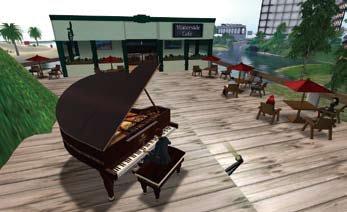
The virtual landscape of Second Life (SL).

The virtual landscape of Second Life (SL).

By Jean-Julien Aucouturier

With nearly 1.5 million members, could concerts in Second Life be the future of music?

The two artists, both professional musicians, couldn’t be more different.

One is a live-show powerhouse, playing more than 20 sell-out gigs per month. His fans travel from all over the world just to see him, and many have been following him since the early days. In between concerts, they blog about the shows. During the concerts, they tip so fervently that money literally piles up on the stage.

The other is not reaching the audience he deserves. Embroiled in a disproportionate network of industrial interests, his artistic freedom is jeopardized and his music denied radio airplay. His tour manager is fixing abusive ticket prices, which are beyond his control. His current contract rips off more than 70 percent of his potential revenue. Like many of his fellow artists in the same scene, he is incredibly tempted to simply give his music away for free, craving for a way to just reach his audience without all the hassle.

Musicians can reach people they wouldn’t have been able to previously.

Musicians can reach people they wouldn’t have been able to previously.

The second of these two musicians is the recipient of 19 Grammy Awards, Bruce “The Boss” Springsteen. The first is Komuso Tokugawa, a robot-like 3D avatar who sings the blues in the virtual world of Second Life. Many will resent comparing the author of “Born In The USA” with what is essentially a creature of pixels and bytes. Introduced in 2003 by California-based Linden Labs Inc., Second Life (SL) is a computer-based recreation of the real-world, entirely built by its users—now a thriving community of over 1,400,000 people. Like in a video game, real-life users of SL appear in virtual reality as 3D characters—or avatars—and they can interact with other users’ avatars and their environment. Certainly, there is an irreducible difference between singing in front of the 98.7 million viewers of Super Bowl XLIII, and singing into one’s computer to a virtual audience of a few tens of 3D characters. But the question here is not whether virtual worlds like SL offer conditions for music that are better or worse than, say, the radio or the mp3 before them. The key question is whether the emerging micro-economy of music in SL is a fad or a trend, something so strong maybe as to shape the future of the music industry. Something that technology will have to follow, rather than create.

Playing one’s own music for a virtual audience doesn’t require a lot of technical know-how. With a microphone and an audio interface, one can capture sound live in a computer at home or in a studio, and set up this computer as an internet radio server to broadcast the audio stream to the computers of your audience. If at the same time, the performer is present in virtual reality as his/her avatar, and the audience is too, you’ll get a complete virtual recreation of a gig. This relative simplicity explains in part the formidable popularity of live music events organized in SL. A survey in September 2007 showed that 58 percent of the events advertised on a typical SL day are live concerts and another 38 percent are DJ/Club events.

Interestingly, music in SL is nearly never recorded music; what matters is the live performance. In a sense, this jumpstarts a trend that the real-world recording industry has been resisting for years now: its, well, death.

Interestingly, music in SL is nearly never recorded music; what matters is the live performance. In a sense, this jumpstarts a trend that the real-world recording industry has been resisting for years now: its, well, death. According to the Recording Industry Association of America (RIAA) CD shipments in the United States were down 20 percent in 2006, and again down 17.5 percent in 2007—something the RIAA readily attributes to illegal file-sharing on the Internet, but academic research rather identifies as the end of an age. What is under question here is the very value of fixing music on a medium. Leonie Smith, a jazz singer in real-world and a SL TV host by the name of Paisley Beebe, puts it in a deceptively simple way: “In the real world, you might never get to see your favorite musician live. This is why you buy CDs. In SL however, you can teleport out anytime if you want to catch that musician maybe once a week, maybe eight times a week.” If seeing a given artist live becomes a commodity, who needs to acquire a recording? Many real-world musicians have stepped in this direction already: Trent Reznor and his band Nine Inch Nails made the news recently for sharing with their fans more than 400 Gigabytes of unedited, raw concert videos in HD format via their Website. What SL brings beyond this is that in the same time it takes to play an iPod, one can actually be in the concert and experience it as part of the crowd.

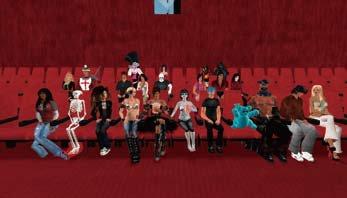
The new face of an audience for artists?

The new face of an audience for artists?

If you’re like me, you’ll probably feel skeptical at this point. Experiencing a virtual concert conjures up visions of uninspiring 3D polygons, awkward navigation with a mouse and keyboard and avatars mistakenly rendered half-way through a pillar or a wall. All of this is true. But what is also true is that, despite all the glitches, the feeling of being there is absolutely astonishing. Watching a concert with your screen flushed with a constant flow of text comments from the audience, hearing the sound of clapping and fans calling out to the band with their real voice (if it works for Skype, it does here too) as well as seeing the performer obviously reacting to all this, addressing people by their names, taking song requests—all this leaves one wondering if there is actually anything missing from the real-life experience of music. Technology is constantly improving, and we will soon be able to teleport at will in the middle of an ongoing music video of perfect HD quality. Already, in June 2008, hit UK pop star Kirsty Hawkshaw had the video of her song “Hypoheretic” shot in a virtual world, in “real-time 3D.”

The experience is good for the artist too, it seems. Doubledown Tandino, a well-known DJ in SL, says it’s even better than the real thing “because all the people that are listening love what they’re hearing— else they’d just step out and teleport to the place that does have the DJ they want to hear. The crowd is always much more appreciative and respectful than in RL [Real Life].” How about the audience lacking body language and real-life responses? “It’s replaced by a different sort of energy. It’s about the shared musical experience, blasting the tunes and being locked in great conversation that fills up the night with a great experience for everyone. There is a way to read a virtual crowd by the way it texts or tips.”

An example of an SL venue.

An example of an SL venue.

And that is the crux: connecting with the fans creates revenue. SL has its own currency, the Linden dollar $L, and it has an exchange rate with the U.S. Dollar. In other words, the money one makes in SL is real money. In our study of the 57 Djs in the SL Club Vortex, we found that most people tip at least 50$L per DJ set, with an average of 100$L (c. 100 yen). The average tip jar earned per set by a DJ is 1000$L (c. 1000 yen), with peaks at 5000$L (c. 5000 yen). These amounts are smaller than their real-life equivalent, but then nothing prevents you from playing tens of performances every month, as potential venues are just one “teleport” away. “Performing virtually has a number of advantages over RL,” says Paul Cohen, the Tokyo-based brain behind Komuso Tokugawa the BluesBorg, “instant setup, no travel from home studio to gig, and less wear and tear on gear.” Over the past 3 years, Paul/Komuso has played over 800 concerts in SL, topping at more than 40 a month. Even with only a few tens of dedicated fans at each concert who are ready to tip (about 60-70 percent of my gig audiences are regulars), this is clearly not a bad business to get into—one that is reminiscent of Kevin Kelly’s vision of an independent artist needing only 1,000 “true fans” (that will buy anything he/she produces) to reach sustainability.

All this SL activity is starting to reach out too. Real-life companies increasingly hire SL musicians to advertise their brand into the virtual world (for instance, DJ Tandino was contracted by Playboy in 2007). The recording industry itself is said to scout SL for new talents. In August 2008, SL bluesman Von Johin signed what is believed to be the first record deal offered to an avatar, with the independent label Reality Entertainment. Not surprising, says Sho Iwase, music industry expert in Gerson Lehrman Group. “Japan has many examples of artists receiving massive The majority of the money made is made from live performances.

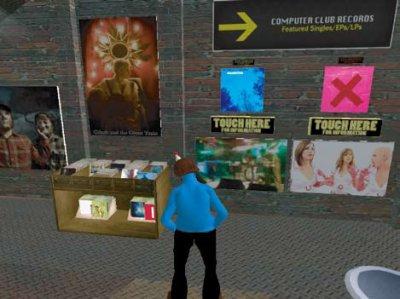
While record stores exist, the majority of the money made in the virtual music industry is made from live performances.

popularity online through websites like Niko Niko Douga [the Japanese YouTube] and eventually managing to earn themselves a record label contract. Rapbit and Kurikinton Fox are two prime examples.” You start by uploading a video of yourself rapping to an anime theme song and you end up signed to EMI. The transition might be difficult, though, warns Iwase: “Virtual music fans like the musician because he/she is unknown and is “close” to them. Once he/she becomes popular, fans no longer feel needed and tend to move on.” Von Johin’s weekly concerts in SL remain free for now, but his debut album is planned to reach iTunes and Amazon at the end of this year and some compromises may be needed on the way.

This shows that eventually virtual worlds like SL cannot stand alone as a replacement for the current system. “It’s just a tool, and I’m just connecting worlds,” says Paul Cohen/ Komuso Tokugawa. But in the process, blues-singing robots like Komuso are also showing that there are still ways to make a living doing just what music should be about: playing and getting heard. And this is good news, especially for Bruce Springsteen. JI

-

JJ Aucouturier is an assistant professor of Computer Science at Temple University, Japan Campus. He is an expert in audio technology and artificial intelligence, with a background in the music industry. More on jj-aucouturier.info

The article above came from HERE

http://www.japaninc.com/mgz86/real-music-for-virtual-world

------


Friday, June 12, 2009

Why Bands Should Avoid the Myth of the Rockstar

Why Bands Should Avoid the Myth of the Rockstar
by Nick Fitzsimons from Penny Distribution

Nick Fitzsimons founded Penny Distribution in 2007. Originally a physical and digital distributor, Penny has since evolved to include booking, promotion and marketing services for its artists and labels. Nick also helped organize UnConvention Belfast and the NI Music Industry Meetup
series.

Peers, Friends & Fans

It’s one of the most memorable scenes from “This Is Spinal Tap” and marvelously summed up the prima donna cock-rock superstar. Tap’s guitar player, Nigel Tuffnell, draws his managers attention to the buffet plate back stage, complaining about the size of the bread, and that he can’t make a sandwich with tiny bread – “It’s a disaster!” he squeals like a 5-year-old.

Rightly or wrongly, the mythos exists that being in a “successful” band means being waited on hand and foot, being lord over all you survey (labels, partners, peers and fans) and that hissy-fits and difficult behavior can be excused because you’re an “artist” – some would even say that being difficult is a pre-requisite of being a true artist.

The truth is that working in music is essential working with people. Despite the appearance that a musician has single-handedly conquered his particular domain, there is a subtle and intricate network, usually numbering into the hundreds of people, who’ve all played their part in propping up this particular house of cards.

If you operate under the assumption that success in this industry can be achieved by you alone, you’ll probably last as long as one of Spinal Tap’s drummers.

And this applies to music businesses, too. Working as a label or promoter is such intensive work that it can be far too easy to become absorbed with your work, never looking up or taking time to see if there’re other businesses or individuals involved in similar or possibly complimentary activities.

With that in mind, I think we can divide the types of people that really matter into 3 groups.

Peers:

These include artists, songwriters and other music businesses. The myth exists most strongly here – other businesses are the “competition”. (for the sake of this piece I’ll call all artists & music enterprises “businesses”). They might steal your ideas.

In today’s music business, I think we need to blow this thought out of the water. Ideas are so numerous people are giving them away. Whatever the idea, it’s the execution, not the idea , that matters most.

Not only that but interaction with other businesses is begun in the spirit of co-operation with the goal of mutual benefit or the achievement of common goals.

Of course you need to work with people you trust, with companies who share your outlook and ethos – but pulling down your shutters to the outside world because the chance exists that things may not turn out well is a sure path to failure.

Get out to networking events or start your own. Anything that gets your peers into a room together, talking to as many people as possible is of benefit. That was a main motivating factor behind UnConvention Belfast (and, I believe, Un-Convention in general) as well as the now-monthly Northern Ireland Music Industry Meetups in Belfast that followed on from UnConvention.

It’s not a question of competition or stealing ideas. It’s simply a question of optimism (think of what we could achieve together!) versus pessimism (they’ll abuse my trust and betray me somehow). Where do you stand?

Friends:

These include bloggers, interviewers or radio – anyone who, for whatever reason, is interested in your music and is taking the time to talk to you about it.

Research the company behind the interview, find out who listens or comments on the content but above all else be enthusiastic.

I’ve heard so many stories from people in radio where the rock ‘n’roll ethos is so prevalent (among established and emerging acts alike) that the band or songwriter treats the interviewer with indifference, or worse, with “don’t-you-know-who-I-am?”-style contempt.

The truth is, no matter how successful you are, every person you interact with as a business has the potential to change the game for you and your endeavors. The problem is that there’s no way to tell who that’ll be – by acting like a Rockstar you’re basically destroying any chance that one of these people will help you in the future.

Fans:

I’ve talked quite a bit about how to treat your fans, but the basic tenet to understand is that they have as much control over your success as any writer from Pitchfork or WOXY.

The amount of times I’ve seen bands treat their audiences with contempt is beyond count and, although disasters like Wavve’s recent meltdown in front of an audience of potential fans at Primavera are rare, there’re plenty of other missed opportunities.

Most bands will say “thanks for listening” after a show, but are they really thankful? If they are, how are they showing it? How about writing an email the day AFTER the show to thank attendees, including a demo of the new track you just wrote? Or making sure fans leave with some music as a tangible “thank you”?

The goal in all of this is that the next time you’re working on a new business idea / have a tour to promote / playing a show in someone’s town, you’ve earned the loyalty of people you interacted with the last time you were there.

Do you think you’ll have that loyalty if you run step-by-step through the Rockstar playbook?

I’d say if you toss aside the Rockstar shit, if you act with genuine enthusiasm, humility and with a sincere recognition that it’s a privilege to work in music, you’re much more likely to have that loyalty.

DIGG IT

(Doubledown Note: I found this article to be spot-on, quite interesting, especially because I think it completely holds true in Second Life and virtual worlds as well as the real world.)

Tuesday, June 2, 2009

Second Life Music can Equal Success and Profit - Part 1: Possible Goals

Second Life Music can Equal Success and Profit - Part 1: Possible Goals

The virtual world of Second Life allows for a collaboration of people to come together to create a real-time live music event. In SL, there's a vast range of music performances. The measure of success is completely relative to the people involved. Everyone's goals are different, while many goals are similar and will overlap each other. Some performers are content with simply playing inworld to people across the globe. Some venues are simply content as being a land space for a live music event to occur. Meanwhile, some performers & venues have complex productions most everyday of the week, booking SL talent nonstop, and utilizing multiple event staff.

In part 1 (of my 3 part series): "Second Life Music can Equal Success and Profit", I want to discuss the possible goals surrounding a live music event in Second Life. (Part 2 will organize the roles of each person involved in a successful and profitable live music production. Part 3 will discuss possible avenues and approaches to making more profit from an inworld music event.)

I want to begin by discussing ways an individual performer and an individual venue can come together with their plans and agendas in order to generate a money flow. It IS possible, especially because the effort and passion is usually already present.

Possible Goals of a Live music event:

* To perform (obviously) - This goal is accomplished when the performer can perform a show and has performed a show. The performer gains experience & practice - This 1st goal, of course, the easiest to reach. When the performer is performing the show is happening.

* To express yourself / To stay true to yourself - This is the artistic & talent side to the show. Fortunately for Second Life, the music performing artist isn't the only artist in the room. In fact, it was an artist that built and designed the room. I even view the team involved in a venue as being artists. The goal of self-expression in SL; It is what it's all about. Anyone that does anything in SL is fortunate to meet their goal of self-expression. It's impossible not to. For performers and venues, staying true to oneself is usually what it's all about too.

* To create the ability for a performer to play music to people - For the performer & the venue, when this goal is reached, exposure & audience is present. Slightly different than the performer simply performing, this is about creating a fan base for the performer, the venue, and the team involved. Any person that arrives to a show has already been exposed just for arriving, and now is a potential (something); potentially a word spreader, tipper, investor, shopper, CD buyer, talent booker, etc. The reason someone arrives to a music show is usually, 'said live performer is performing'... however those reasons can be revised once they arrive.

* To create a family, crew, team effort relationship around the owners and staff of the venue - This is a very important goal to most venues, and also to the performers choosing which venues they perform at. Many successful venues inworld stay successful, with their doors open, when the love and passion from all people involved is there. Especially when profit is NOT a goal, creating the family/friends vibe for a venue usually becomes an important goal.

* To create a popular venue with a unified team. This continues beyond "building the team effort" which I mentioned above. This goal is about presenting and perpetuating the reputation to the public. When the performer is booked, this is where the venue, performer, & team involved, needs to either capitalize, or just sit back and enjoy the show they've produced. Many venue owners and staff do it for the love of it... and that's a goal too. Meanwhile, booking the performer in the venue and having the show actually happen, sometimes is only the beginning, not the satisfying end result. Venues (the management, staff, performers) need to keep in mind: what are the real goals in bringing all these people to the venue other than to listen to the performer. Is it to add fans to a group, is it to sell products in a nearby vendor, is it to perpetuate the club's popularity by announcing future shows?

* To create something unique, revolutionary, ahead of it's time, and beyond the norm - After a venue or a performer has settled into their routine of SL performances, sometimes they want to explore new creative options of entertainment or stimulus and revolutionize their standards. Examples of this could be lining up a full day of performers for a festival, themed events, or basically just adding anything unique into the show. Also, many locations inworld aren't build to be a music venue (such as an art gallery, or a sim opening event). In their own way, these locations are creating something unique simply by having a live performance.

--- ----
Above I listed one set of goals, more aimed at fun & enjoyment plus exposure as being the high standards. Below I list the goals involving monetization. The goals below; not for everyone. Many sway into differences of optinion, and some choose not even to make money or profit part of the equation.

* To create traffic - This is the goal of having avatars at an event and to create traffic. I don't mean the land traffic calculation number, I mean the general flow of people in and out, the traffic. For example, think of a website... it gets on average 100 people to visit the website a day. That is the traffic. It doesn't mean the people that visited were quality, or even read the webpage, but it does mean people were there and pageviews happened. With some venues and performers, their main goal is simply "the traffic." A large crowd is obviously better than a small one and gaining/maintaining the traffic seems to play a large role for some. The goal of traffic is also a great way to combine all walks of life into one music event. Usually a traffic-aimed event is filled with not only music fans there to see the show, but also newbs, randoms, and the nonmusic public in SL.

* To make money as the performer, venue and staff - The profitability is a goal for some. Usually more often, we hear the venues are in need of making profit, because plain and simple: making profit above the cost of land, rent, bills, payroll is the business plan... or more like the business dream. It seems that when people start a club in SL, they either set out from the get-go and declare they are not in it for the money... or... they start the club, and soon find out just paying club expenses isn't making them money, and instead it's going to render them bankrupt. Some venues choose to disregard making money and I applaud the efforts. The same goes for performers. Some performers in SL do not let making money factor into their SL music hobby. Meanwhile, performers and venues, many have the goal of profit. It's a dance, finding ways to be profitable without selling out or feeling compromised. In part 2 of my SL music: success and profit series, I will delve more into the profitability goal.

* To create profitability by sales. Some venues choose to have sales intermingled with their venues, either as a shopping area attachment, or some selected items on display near the dance area. Some venues charge admission. Some performances and events charge a cover as well. Performers have the ability to display music for sale at each of their shows. All of these aspects can be a reason for any event.

* To create an avenue for sponsorship. Advertisers and sponsors need to get their word out. A public venue or a performer (in RL and SL) is a great way to get that word out. A goal can be to gain a sponsorship business relationship in order to offset costs. By doing events, the sponsors receive their promised agreements (business relationship reputation)

If you're a venue, what are your club's current goals? Is it to keep booking performers? Is it to stay packed? Stay popular? Is it to build a large following for the club? Is it a place for performers and community to simply jam? Is it a mutlicomplex that offers more than a music location?

If you're a performer, what are your current goals? Is it to perform as much as possible? Is it to sell your music? Is it to hit people with your sounds around the world? Is it to become popular in real life? Is it to make money? Is performing in SL a way to continue practicing?

If you're a venue manager or staff member, what are your current goals? Is it to perpetuate the passionate support of the venue and crew? Is it to help make the club money? Is it to simply have a job in SL?

If you're a performer manager or booking agent, what are your current goals? Is it to book as many of your performers as possible? Is it to build a strong relationship with several performers and help build their career? Is it for the money and the commissions? Is it for the noteriety?

PLEASE let me know more in comments and I'll add here in updates. I'm looking to somehow conform this into a group made article, so please, use comments, let me know any thoughts, and I will work them in on revisions with credit.

Doubledown Tandino

Tuesday, May 26, 2009

The words "Riffage" and "Meatspace" Added to the Dictionary

I've long been a fan of the creation of words by prefix or suffix. English language has taught me that it is only a theory, written by the historian, The Man. Meanwhile the most used words of our lexicon are probably found at Urban Dictionary these days. I've always created words by adding -age , -ish , and -ness to be more descriptive, and I think, just because it's a word not in the dictionary yet, doesn't mean it's not a word.

Riffage

n. guitar riffs.

Slightly more annoying than making nouns into verbs for no reason ("hold on, I'm Twittering!") is the trend of pluralizing them with "age". No need to say "make love" when "humpage" will do just as well. And hell, we can label all fire alarms with "Fuck, burnage!" to make it that much clearer to everyone.

---

Meatspace

n. The physical world, as opposed to virtual.

Doubtlessly coined by a level 80 Druid tank somewhere in the World of Warcraft, it's a sad day for the species when what you may recognize as that in which everything exists, needs a special term to differentiate it from the "real" world of Facebook friends and LOLcats.

Soon you'll hear it used in sentences like, "So all of the crops are dying and the air is turning poisonous? Bah, who cares about all that stuff that happens in lame old Meatspace."

---

Check out the full article "15 Words you Won't Believe they Added to the Dictionary" via Cracked.co

Monday, May 25, 2009

Music Clubs in Second Life: A Labour of Love (Editorial by Thunda Masala)

Music Clubs in Second Life: A Labour of Love
By Thunda Masala of "Twisted Second Life"

The biggest attractions and entertainers in Second Life are also the biggest losers.

Music clubs have a special place in Second Life. They are more than their music; they provide a place for people to meet, chat, listen to their favorite music and dance. A lot of social thing goes on in the clubs. They also are places for people to show off their newest acquisition and fashion sense.

Since Second Life does not have a ‘directed’ game plan in the virtual life, it is safe to assume that clubs evolved as one of the earliest means of entertainment on the grid long before voice chat was introduced.

read more | digg story

Tuesday, May 19, 2009

The Future of Music (discussion by Komuso) (New World Notes)

Mixed Reality Komuso On The Future of Music Online
By Hamlet Au of New World Notes

"This is an extremely interesting and incisive talk on the future of music online from someone uniquely qualified to speak on it: the man behind metaverse blues master Komuso Tokugawa, the voodoo-flavored avatar who fronted some of Second Life's most innovative live music shows, including live combo performances between Komuso from Japan and musicians in Taiwan and Canada. (The audio on the presentation computer wasn't working, so I've embedded the two videos he's talking about after the break.) He speaks a little about how those were done from the technical side, and weaves that into a smart analysis of where Internet-driven music is going (and where worlds like SL fit into that scheme.) My favorite bits: Komusu cites a Japanese university study on live music performers in Second Life, which reports that the upper end of earnings for "a small number of us" is $40-100/hour. And this line: "The record industry is dead, love live the music industry." Burn those words outside the entrance of the RIAA, baby."

WATCH THE VIDEO HERE

read more | digg story

Sunday, May 17, 2009

Q and A: The Poor Man's Copyright

Poor Man's Copyright

Q: My friend and I have a bet. I say mailing myself a copy of my songs is a valid copyright. He says it's not. Who's right?

A: Start writing the check; your friend is right, and mailing yourself a copy of your songs is not valid legal protection against copyright infringement.

Although technically a "copyright" takes place the moment the songs are created, mailing your songs to yourself unopened--sometimes called a "poor man's copyright"--provides absolutely no protection in the event of a lawsuit. In fact, according to several entertainment attorneys we spoke with, if you have not registered your copyright with the US Copyright Office, no court will hear your case. So, in order to protect and enforce your copyright if someone tries to steal your songs or sue you for infringement, you must register your songs. In the Court's eyes, if you haven't bothered to register the copyright with the US Copyright Office it's just not worth their time.

Forms and information are available at the Copyright Office. (We especially like Circulars 50 and 56.)

read more | digg story

Tuesday, March 31, 2009

Stealing Music: Is It Wrong Or Isn’t It?

Stealing Music: Is It Wrong Or Isn’t It?
by Michael Arrington on March 31, 2009

"...But over the last few years the line has blurred to the point where there really isn’t any line any more. We can listen to free, on demand streaming music at MySpace Music and lots of other sites. It’s ok to do it at MySpace, but it’s wrong to do it at Project Playlist, just because the right contracts aren’t in place? Just a couple of years ago anyone listening to free streaming music anywhere on the Internet was violating copyright and subject to being labeled unethical. Today, its no problem. And you don’t even have to listen to audio ads..."

read more | digg story

Above is an excerpt. Be sure to read his full article and opinion.

Monday, March 30, 2009

Promotions, Promotional Events, Music, Audio, and The Music Biz in Second Life - Three Articles


Three interesting articles popped out today and were brought to my attention by Mal Burns
I find these posts very important. Bookmark the articles; they may come in handy for you some day.

Everything written in each article is worth the read, however, if I were to add my personal note for the reader, I would say that generally, articles about "how to run a successful event" or "how to run a successful promotion" explain the basics of how to technically and logistically create a basic event. For me, what is most effective about an event I create is the creativity, the guts, and the people involved. Finding ways to NOT fit the mold is what I feel works best in Second Life.

-----

Overview of Music and Audio in Second Life
"Second Life is a great place for people who enjoy listening to or creating music. People who like to listen to music will find a wide range of styles and unique venues to explore. Musicians can share their work with a global audience by performing live concerts in Second Life. It's also a unique opportunity for artists to directly connect with fans around the world, taking requests and communicating with them in a live environment. Just like playing a gig in Real Life, but without the hassle of carrying your gear around and traveling!
-----

The art and science of promotional events
Written by Rika Watanabe on Through the Broken Looking Glass

"...Repeat after me: Promotional events exist to promote sales and increase exposure. They don’t exist to promote hate and increase lag, which is what you’re doing! How exactly promotional events and most importantly, promotional giveaways promote sales?..."

READ THE FULL STORY HERE

-----

Promotions and the music business in Second Life
Written by Thinkerer Melville of http://rezzable.com/blog

"Music is a business? It is to people who want to make a living at it. An important part of that business is promotion. I have been developing some ideas about how musicians can promote their acts in Second Life. When I get the ideas well developed, I will put them into the Hobo Starter Kit, but I think I have enough useful material to share some of it here.
Musical acts in SL might want to promote to these four target markets:
  • Venues and event managers (get a gig)
  • Inworld audience (fill the house)
  • Out-there audience (Sell your music for now. Future: sell your performances.)
  • Advertisers/ Sponsors (Get paid for ad placements and commercials)..."
READ THE FULL ARTICLE HERE

-----

Saturday, March 28, 2009

RIAA, MPAA Copyright Warnings: Facts and Fiction

RIAA, MPAA Copyright Warnings: Facts and Fiction

Written by Ernesto on March 28, 2009


This week several scary stories surfaced about how the MPAA and RIAA are negotiating with ISPs on how to deal with copyright infringers. Even though it was often presented as news, those who look deeper will realize that this is nothing new at all, just the same old threats dressed up in a new jacket.
It’s has been a good week for the entertainment industry lobbyists. Hundreds of news outlets wrote in detail about how the RIAA and MPAA are negotiating with Internet service providers to warn alleged copyright infringers. No one seemed to notice that this isn’t really news as they’ve been working together for years, with ISPs passing on warnings to their customers on behalf of the studios.
It all started with rumors about two US ISPs, Comcast and AT&T, who were said to be doing a three-strikes deal with the RIAA. It soon became known that this rumor was completely fabricated, but not before hundreds of other news oulets reproduced the story. At the end of the week it turned out that there was no news at all.
Yes, the RIAA, MPAA and other outfits do plan to send copyright infringement warnings to ISPs, but they’ve been doing so for at least half a decade. Every other month these Hollywood lobbyists pitch their anti-piracy efforts to the public, and that’s exactly what they are paid for. This doesn’t mean, however, that something is about to change.
The anti-piracy outfits are happy with all the free publicity of course, that is exactly what they are after. Their purpose is to scare people. In this post we hope to clear up some of the misunderstandings, as we show that the scary stories published this week have no substance at all.

Copyright infringement warnings?

For years, content owners such as record labels or movie studios have been sending copyright infringement notices to ISPs, who are legally obliged to forward these to their customers. Some ISPs simply ignore them, while others faithfully forward the emails to the customer account associated with the infringing IP-address. Many ISPs don’t keep records of these events.

So, is my ISP spying on me?

No. This is a common misunderstanding. ISPs don’t look into your specific downloading behavior, they never have and there is no indication that this will change anytime in the near future. All the ‘evidence’ comes from organizations that work for the copyright holders.

What do they know about me?

If you receive a warning, all copyright holders know about you at this stage is your IP-address and what files were (partially) shared via your account, or more accurately - the bill payer’s account. The MPAA, RIAA and others don’t know your name and they never will unless they get a court order forcing your ISP to hand over the information. In the bigger picture, this is very rare.

How did they track me down?

The copyright holders hire companies such as BayTSP and DtecNet to track down people who share certain titles on BitTorrent and other file-sharing networks. They join the swarm and request files from others. When someone shares a piece of the file with them they log the IP-address, look up the ISP and send out a copyright infringement notice automatically. Unlike the file-sharers, these companies are authorized to download these files, so they are not infringing copyright themselves.

Will I get sued if I receive a warning through my ISP?

No. These copyright infringement warnings are not related to any legal action. Copyright holders do go after people who share their work on file-sharing networks, but this has nothing to do with the warnings they send out via ISPs.

Will they take my Internet away?

No. Although there is a lot of talk about “three strikes” policies, no ISP has agreed (or was forced) to disconnect users after they receive their third warning. In New Zealand they came close to implementing a law that would require ISPs to do this, but this proposal was pulled.
In France they are also considering three strikes legislation, but this has not passed into action yet. In Ireland the largest ISP Eircom said it would disconnect repeated infringers only if they receive a court order.
It is worth mentioning though that ISPs may cut off people whenever they think it’s necessary. Cox does this in the US for example, without an agreement with the MPAA or RIAA. ISPs have terms and conditions and most forbid copyright infringement, but really this is just to cover their own backs under the law.

Do I have to be worried?

Receiving a regular infringement notice is nothing to be worried about. However, if you download copyrighted files without authorization from the copyright holder you are breaking the law in some countries. If you receive a warning without having shared anything yourself (which happens quite often) then there’s nothing to worry about.

Can I protect (hide) myself?

If you don’t want to be spied on when using BitTorrent the best option is to hide your IP-address. You can do so by subscribing to a VPN service or by using software such as TorrentPrivacy. Blocklist software such as PeerGuardian is often recommended, but it is also highly ineffective as the lists are never fully up-to date or accurate.

What’s the point in all this?

The MPAA and RIAA don’t want their products on file-sharing networks and they use these warning emails to deter people from sharing these files with others. Since it’s much cheaper (and effective) than suing people, this is now their strategy of choice. Using news outlets to spread their doom and gloom scenarios is just part of their operation.
In the future the amount of warnings they send out to alleged infringers will increase and the studios and ISPs will work together to keep the associated operating costs down, if that’s not what they’ve already been doing in their recent meetings. It’s just the old model, scaled up with a rumor or two on top.
Let’s move on already.
read more | digg story

---

Doubledown's Note: To me, this all rings true in relation to the gray area involving live music streaming into Second Life and the licenses we may or may not need.

Tuesday, March 17, 2009

VIDEO NOW POSTED! Music Biz in Second Life on Metanomics


Thank you to Remedy, SLCN.tv, Beyers Sellers and Metanomics for having us on the show! Metanomics looks at the business of music in Second Life™ with the Blarney Stone's Ham Rambler, JenzZa Misfit of Muse Isle Connection, DJ Doubledown Tandino, and musicians Grace McDunnough, Cylindrian Rutabaga, and Dann Numbers. On the Spot, Dizzy Banjo helps us place the conversation within the larger context of virtual world soundscapes.

read more | digg story