Showing posts with label Technology. Show all posts

Monday, December 13, 2010

Faust & Shortee on SSL with the Traktor Kontrol X1 controller

The dynamic duo behind drum & bass outfit Urban Assault and labels Heavy Artillery and 5 Star Recordings Faust & Shortee perform a scratch and controllerism routine to perfection, taking advantage of the Traktor Kontrol X1's intuitive control over track browsing, looping, cue points and effects in Scratch Live.

With some of their own musical arsenal and customized faceplates on their X1 controllers, they perform a four-turntable routine short of none. Find out how seamlessly the X1 controller fits a Serato Scratch Live setup as a MIDI controller for increased creative potential.


Thursday, May 13, 2010

The Vocoder: From Speech-Scrambling To Robot Rock

The Vocoder: From Speech-Scrambling To Robot Rock
by NPR Staff

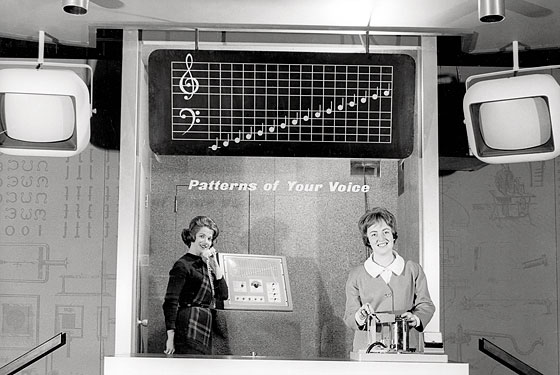
If you've listened to pop music in the past 40 years, you've probably heard more than a few songs with a robotic sound. That's thanks to the vocoder, a device invented by Bell Labs, the research division of AT&T. Though the vocoder has found its way into music, the machine was never intended for that function. Rather, it was developed to decrease the cost of long-distance calls and has taken on numerous other uses since.

Music journalist Dave Tompkins has written a book about the vocoder and its unlikely history. It's called How to Wreck a Nice Beach: The Vocoder From World War II to Hip-Hop.

Tompkins says the machine played a significant role in World War II. After the U.S. government discovered that Winston Churchill's conversations with Franklin D. Roosevelt were being intercepted and deciphered by the Germans, it decided to invest in speech-encoding technology. So the National Defense Research Committee commissioned Bell Labs in 1942 to develop a machine — and Bell Labs delivered.

The vocoder wasn't without its flaws. Intelligibility of speech sometimes proved a problem, but Tompkins says pitch control was a bigger concern.

"They didn't mind world leaders sounding like robots, just as long as they didn't sound like chipmunks," he says. "Eisenhower did not want to sound like a chipmunk."

READ THE FULL STORY HERE

Friday, May 7, 2010

Social Media Revolution 2 (video)

Social Media Revolution 2 is a refresh of the original video with new and updated social media and mobile statistics that are hard to ignore. Based on the book Socialnomics by Erik Qualman.

Saturday, April 10, 2010

Top 5 Augmented Reality Business Cards

Augmented reality (AR) is a term for a live direct or indirect view of a physical real-world environment whose elements are augmented by virtual computer-generated imagery. It is related to a more general concept called mediated reality in which a view of reality is modified (possibly even diminished rather than augmented) by a computer.


Wednesday, April 7, 2010

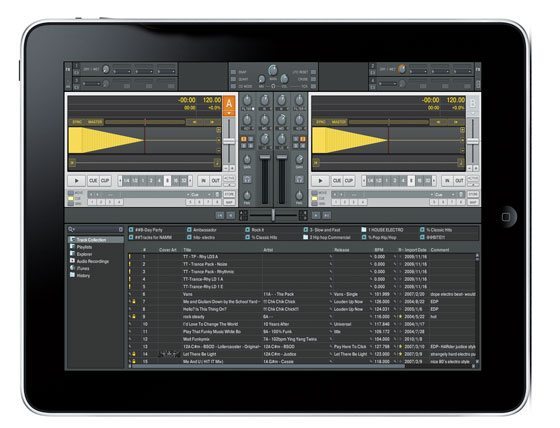
DJing with the iPad? (NOT!)

Ipad_traktor

Djing with the Ipad? 

The internet is heating up with news about the Ipad, Apple’s new touch screen interface. Between rave reviews from some and boo’s from others that are calling it a giant iphone- you are probably wondering, but can I dj with it?  Lets take a look at what might actually be possible with the new ipad, and if it cant replace your dj laptop- perhaps it might be the low cost touch controller you have been waiting for?


THE GOOD

the-good
Here are a few of the key features that are dj friendly:
  • 10 hour battery life means you can play without being plugged in at all.
  • Multi touch screen means lemur qualities without the lemur price
  • one model boasts a 64 GB hard drive which can hold a fairly large dj set.
  • some models will cost as little as $500 (WI-Fi model with 16gb)
  • 1GHZ processor is not blazing but might be enough to play a few dj tracks (but nothing too complex like keylock)
  • Light and very portable, 1.5 pounds, 9.56 x 7.47 x 0.5 inches.
  • Third party hardware developers will be able to create sound card breakouts that improve the audio quality. Comes with a 1/8th” standard headphone out.

THE BAD

the-bad-2

No Standard Ports
third party hardware developers will need to pay apple high royaltys to develop products for the platform. This will drive up costs and limit development. A USB port would have solved most of this.

No SDK access to iTunes library
The ipad has the same closed audio architecture as the ipod and only apple programs can access the Itunes generated playlists and songs. This means a dj program on the ipad must access songs loaded onto the hard-drive and wont be able to read your playlists. Gizmodo reports:
“Unlike the iPhone, the iPad does seem to have some shared storage aside from the photo roll. The newly released SDK reveals that when you connect an iPad to a PC or Mac, part of it—a partition, maybe?—mounts as a shared documents folder.”
not ideal, but it is a potential work around.

There is no RAM
Audio will be written and read from the flash drives directly. While solid state drives are blazing fast, can they deal with highly demanding audio process like djing on their own? We really have no idea- but suspect it might be a stretch. These are designed to stream one song at a time, not four with keylock and effects.

THE VERDICT

the-verdict

Its highly unlikely the Ipad offering will come close to replacing your laptop anytime soon. It is however very realistic that third party developers will port over in-expensive touch apps that will transform this low cost device into a very handy touch screen controller. The trouble remains getting that control data to the computer over bluetooth or wifi without dropouts or latency. This certainly is an exciting announcement for the computer world but not quite the groundbreaking news for djs that some might have hoped.

[This brilliant write-up was written by.  Thank you]  

Looking for more information? Here are few interesting articles on the I-Pad subject.

GIZMODO  “8 Things that Suck About the iPad”
Create Digital Music How A Great Product Can Be Bad News: Apple, iPad, and the Closed Mac
Wolfire Blog “Web applications on the iPad”
Wired   “Apple iPad’s Display Is More Like a TV Than a Laptop”

Saturday, January 30, 2010

Frontline: Digital Nation - 90 minute Documentary airs Tuesday, February 2nd

Ark Media and PBS-FRONTLINE: our 90-minute documentary "Digital Nation" will be airing on PBS on Tuesday (February 2) at 9 PM EST (check your local PBS listing). 

This unprecedented FRONTLINE project tackles what it means to be human in the digital age, from the way we think, work, interact and connect to the way we fight wars. We visit lots of places -- labs performing fMRIs on heavy multitaskers to a wired middle school in the south Bronx; an internet addiction boot camp in Korea to a massive American corporation holding meetings via avatars; a controversial Army recruiting center outside Philly to an Air Force base in the Nevada desert where pilots fly planes remotely.

We have an extremely rich and robust website, full of content we've been gathering over the past eighteen months as well tons of videos sent in by people across the globe. It's unlike any FRONTLINE website before, and we hope you can check it out after the broadcast. Douglas Rushkoff, one of our correspondents, will be hosting an online roundtable with many of the people you'll see in the documentary. We'll also continue to update the site with fresh video, and as always we invite any and all comments about any part of the site or the documentary.  pbsdigitalnation.org

Cheers,
Ark Media 


?ui=2&view=att&th=1267b2ef4e8c2e06&attid=0.1&disp=attd&realattid=ii_1267b2ef4e8c2e06&zw

Sunday, January 10, 2010

Panel at Berklee College of Music & in Second Life - Monday, January 11th - 12:25 SLT


Panel at Berklee College of Music & in Second Life
Monday, January 11th at 12:25 SLT

Robert Thomas, also known as Dizzy Banjo in SL will be taking part in a panel discussion about music and virtual worlds, held at Berklee college of music and in Second Life. The panel also features John Lester of Linden Lab ( creators of Second Life ) who does a lot of development work in the field of Education and Healthcare, Grace Buford who has established a successful online presence as the virtual performer Cylindrian Rutabaga, and Andrew Woolf and Perry Geyer ( of Boston based group Fierce Tibetan Gods ). It is moderated by Lori Landay of Berklee.

Mr. Thomas expects he'll be talking about the various pieces of interactive music work he has done in the virtual worlds space for organizations like Princeton University, Mexico Tourist Board, Costa Rica Tourist Board as well as other interactive installations like Parsec, Dare and Gestural Music.

He also hopes to talk about the possibilities of music delivered as software ( on various platforms ). Hw would also like to discuss how virtual worlds could be utilized by the music industry to deliver interactive content and how we could see a focus on the ’social 3d music app’ as a virtual good soon.

Join us for the discussion in SL here !

---

Robert Thomas 1 bw square rounded 500 500Hi there ! My name is Robert Thomas, and I'm a composer interested in unusual ways music can become a soundtrack to your life. I run a small music company called Dizzy Banjo. I also go under the name Dizzy Banjo in numerous social networks and environments.

Wednesday, December 30, 2009

Friday, December 18, 2009

I saw "Avatar" today. My review: It blew me Away!


James Cameron's "Avatar" is one of the most monumental films of this decade, and decades to come. Some may not realize it yet as to why, but, trust me, this movie will be so important for years.  It's on the same caliber of movie as Citizen Kane, Dances with Wolves, and Schlindler's List.

The visual effects and colors were the most magnificent I have EVER seen in a movie (the only movie that even comes close in color is a short segment in the movie "What Dreams May Come"). The 3D technology was brilliant, and the movie was not about trying to make sight gags using the 3D. 


Aside from the technical aspects being phenomenal and innovative, and the visual beauty, the story has so many layers and meanings to our real lives.

There are comparisons, undertones, symbolism, parallels and metaphors that strike deep into the core of any human viewer. Our societies, our races, our world; it hits home.  This movie has so many layers to it. ( I will not reveal anything, so I do not spoil it for anyone.  I don't want to reveal what I picked up from watching the movie.  You will want to go in fresh and absorb on your own. )


James Cameron spent $500 million on it, and it is worth every penny.

This movie is an epic brilliant masterpiece of this century. You may not realize it when you walk out of the theater... but this movie is going to be so important to the entire movie industry, and will last as one of the greatest movies ever made.


You NEED to see this film in the theater and in 3D.   Do not wait for the DVD.


UPDATE:  This Avatar review arrived on Gizmodo:  

Avatar Review: Yes, It Changed Everything After All

This review is a much better write-up on exactly what I am trying to relay in my review.  I am not a movie reviewer, but this review is what I was trying to say.


The point is,  whatever you've heard, or read, or seen in previews, it's nothing in comparison to what the movie actually IS.


Wednesday, December 9, 2009

DJ Rafik chops up the Chemical Brothers sample "Block Rockin' Beats" using Tracktor

Rafik chops up the Chemical Brothers sample "Block Rockin' Beats", triggering individual cue points so he can re-create and re-structure the lick in his own way. On the other deck he runs a hi-hat a Gater and Filter (chained) and a Beatmasher controlled via X1. The result is a blistering performance made possible by TRAKTOR and the X1.


Check out more of Turntable Trickology with DJ Rafik

Saturday, November 21, 2009

Keep Your Headphones Kink-Free - Ultimate Cord Wrapping Technique

Use an Over-Under Wrap to Keep Your Headphones Kink-Free

Headphones have a magic way of tangling themselves in inexplicably complicated knots. Many techniques for keeping headphones tangle-free work but they badly kink and over tighten them in the process. Use an over-under wrap for easy and cord-friendly storage.

Over at HackCollege they tested out a bunch of different cord-wrapping techniques with the goal of finding a technique that was easy to use, didn't impart kinks or curls to the headphone cord, stress the headphone jack, or require any fancy undoing to return the headphones to their natural state. They ended up using an over-under wrap held in place with a simple twist tie. Watch the video below to see it in action—you can jump to around the 1 minute mark to skip the intro and get right into the technique.


[Thanks Lifehacker, Instructables, & Hackcollege]

Wednesday, November 11, 2009

Ogg Vorbis Audio Streaming into Second Life


Ogg Vorbis Audio Streaming *finally* comes to Second Life!
by AntoniusMisfit of "A Misfit's Virtual Life"
 
Yesterday, the latest release candidate build of the Snowglobe viewer was released with relatively little fanfare. But for Second Life residents who use Linux as their operating system of choice, yesterday marked the arrival of a feature long desired: the ability to stream an open source audio format (Ogg Vorbis) within the virtual world.

[READ THE FULL ARTICLE HERE]

Thursday, October 22, 2009

uPlaya - Upload your Song and see if it is a Potential Hit

CLICK:
Uplaya_referral_222b

Hit Potential Technology

It’s your time, uPlaya independent artists, musicians and songwriters.


Hit Song Science™ featured in
CBS’s TV series Numb3rs


Hit Song Science™ and the Music Universe™ power the uPlaya Artist Revolution.

“Online services have helped address the ‘availability’ problem for music, but consumers and artists are still frustrated by a lack of ‘visibility’ to easily connect great artists with potential fans,” “Music Intelligence Solutions’ Music Universe™ and Hit Song Science™ can solve the visibility problem better than any other technology that I have seen.” Chuck D, co-founder of Public Enemy, legendary artist, author and Internet entrepreneur.

Do you dream of a world without boundaries — where you can place your work before a huge audience, with no limits and no interference?

Hit Song Science™ provides immediate feedback on your song´s potential for commercial success and instant legitimization in the market for high-scoring music.
Do you want help choosing the best channels and markets for your music and which of your songs have the best chance for success?

The Music Universe™ helps you understand the hit potential of your songs within different markets and niches, and includes targeted promotional features to help your music gain visibility with audiences who already like your sound.

Our rating system gives you immediate feedback on the quality of your music, its competitive edge in the music industry, and its reception among professionals and music lovers.

For example, if your song receives a Gold or Platinum Audionaut Award (Auddy™), then the underlying musical patterns are similar to songs that have been hits in the past.

The Music Universe™ includes many languages and all genres from around the world. Ultimately, The Music Universe™ will analyze and catalog all music ever created and digitized.

Hit Song Science™ compares the sonic characteristics of your tracks against all the songs in the Music Universe™.
In the Music Universe™, hit songs tend to “cluster” (in terms of similarity), and the likely commercial success of new music is judged by its proximity to these constellations.

Music Intelligence Solutions’ patented algorithms analyze the fundamental characteristics of all music, such as brightness and tempo, and measures how they change over time. Often, these characteristics are perceived unconsciously by the listener, and the correct mix of parameters is more important than any individual parameter by itself.

Detecting Hit Potential and Music Trends

Artists use the Hit Song Science™ technology to compare their unreleased songs against hits of the past and present, allowing them to see how well their music fits into the current market as well as to identify potential hits.
The technology also spots new trends and highlights how new songs fit in with these new trends. So a song containing mathematical patterns that are becoming more prevalent in new trends is detected as having high hit potential.

HSS™ analyzes an album or song and provides multiple components of feedback: song ratings to assess hit potential, song ratings to assess “staying power” and “new trends potential”, affinity values vis-à-vis other artists, and information regarding album coherence.

Monday, October 12, 2009

Blog Love - Pixels and Policy with Max Burns

Pixels and Policy has burst onto the virtual world news, info, and opinion net scene.  Run by Max Burns


Pixels and Policy

Uncovering the ways virtual worlds change our politics, policy, and culture.

Home
Archives
Profile
Subscribe

I highly encourage to you to read & follow the blog covering so many important virtual world issues of the present day and the future to come.

DIGG IT:
http://digg.com/people/Pixels_and_Policy_Blog_about_Virtual_World_Issues

--
(no relation to Mal Burns, who is also an excellent virtual world media expert and journalist)


Thursday, October 1, 2009

Is Intel trying to steal Second Life though an expensive advertising campaign?

I don't even know what to make of this; Intel has decided to release a full-on internet advertising campaign sponsoring many websites, which all leads to this video.   To me, and everyone else in Second Life, and everyone else using Open Grids (Open-source OpenSim http://opensimulator.com) , and everyone else in the world that hasn't been living under a rock for the past half-decade... um, Intel, we know you're trying to steal Second Life.   Calling it Intel's "3D Internet", and obviously ripping off Linden Lab's Second Life, how foolish.

UPDATE:  Since this post Intel has conveniently changed the title of the video, changed the description of the video, and has changed all of the information on their Youtube page.

Thursday, July 30, 2009

A Few Tips on how to continue working when Second Life is Overloaded

Today, literally in 5 minutes is the start of another Metanomics community forum (at Metanomics II in Second Life). Today's topic is "Getting Things Done: Effective Organization in an Overloaded World in SL". If you'd like to attend, I encourage you to hop on the SLURL... now: Metanomics II

I wanted to drop in a blog post about my thoughts and quick tips on continuing your projects and work during times of inworld technical hardships, borkery, and lagginess.

SL breaks down to the point of crawling speed often, and for days at a time... sometimes weeks... months? ... Has it always been in a broken state? No, but SL will always be in disrepair. The residents have come to accept that as a part of Second Life.

But even though SL is suckin' there are still plenty of people in SL, new accounts entering, and things occurring.

You may not be able to work on the custom build you've been wanting to do, or be able to give a good presentation at a business meeting... but you can use this sucky SL time to your business advantage.

1) Straighten up & tidy up. Use this time not to build and create, but more of a time to organize and consolidate. Use the time to straighten up your store, respond to emails, write your SL bio, write a business proposal, connect with others and offer up possibilities. Keep in mind that what is not working in SL is the graphic speed of things... so you can take care of other things on your plate without feeling the lag.

2) Focus on marketing and advertising. Even though your SL day is lagiful, others may not be.

3) Go out and party! Check the events, go to some popular and fun looking spots, and make some friends. You're not going there to explore, you're not really even going there for the event... you're going because there are other people there and you all have something in common: you all hate the lag. The best way to strike up a convo with like-minded business people is to talk about how the lag sucks and how it's affecting your business. Others will agree, and now you're networking. and this is all with chat and IM... so the event may be crazy laggy, but it won't affect your reasons for being there.

4) Spend some time promoting on 3rd party SL-related websites.

5) IM IM IM - You have a massive friends list. Send some people a personal "hi what have you been doing, here's what I've been doing"
They'll be happy receiving the IM.. even if you only ran into em once is some newbie center a year ago.

So yes, I say there's plenty of things you can do when SL is on the down-n-out that'll still keep your business active.

Thursday, July 9, 2009

Second Life to MIDI Interface [video]

This demo shows how an avatars position can be tracked and converted into MIDI data to control a real-life synthesiser and 3D audio system by dadenmedia

Wednesday, June 10, 2009

RJDJ - Dizzy Banjo Explores the Reactive Music Application for the iPhone & IPod Touch

I discovered RJDJ via Robert Thomas a.k.a. Dizzy Banjo, currently working as a reactive music composer.


From his blog article:
Scripting reality – music is everywhere…
Dizzy Banjo writes:

"RjDj is an amazing iPhone application which creates mind twisting hearing sensations by weaving your environment into reactive music. Voices, cars, your walking speed.. these and many other things can be used to shape your experience. If you have an iPhone or iPod Touch, try it!

I had been interested in RjDj from the moment I heard about it, and helped test during its beta phase. It’s come a long way since then with loads of new scenes added. Scenes are reactive musical programs within RjDj, which respond to your environment and movements in different ways. Here are some videos of various RjDj scenes:"

(I urge you to go to his blog for the full scoop. Here's a teaser to wet your appetite.)


DIGG IT

Tuesday, June 9, 2009

Top 30 Failed Technology Predictions

Top 30 Failed Technology Predictions
(I would like to give credit, but cannot find the original source or compiler)

Throughout history man has been making predictions of the future. With the advent of technology, the predictions moved away from religious topics to scientific and technological. Unfortunately for the speakers, many of these failed predictions have been recorded for all future generations to laugh at. Here is a selection of the 30 best.

Predictions 1 – 10

Main Farnsworth

1. “There is no reason anyone would want a computer in their home.” — Ken Olson, president, chairman and founder of Digital Equipment Corp. (DEC), maker of big business mainframe computers, arguing against the PC in 1977.

2. “We will never make a 32 bit operating system.” — Bill Gates

3. “Lee DeForest has said in many newspapers and over his signature that it would be possible to transmit the human voice across the Atlantic before many years. Based on these absurd and deliberately misleading statements, the misguided public … has been persuaded to purchase stock in his company …” — a U.S. District Attorney, prosecuting American inventor Lee DeForest for selling stock fraudulently through the mail for his Radio Telephone Company in 1913.

4. “There is practically no chance communications space satellites will be used to provide better telephone, telegraph, television, or radio service inside the United States.” — T. Craven, FCC Commissioner, in 1961 (the first commercial communications satellite went into service in 1965).

5. “To place a man in a multi-stage rocket and project him into the controlling gravitational field of the moon where the passengers can make scientific observations, perhaps land alive, and then return to earth – all that constitutes a wild dream worthy of Jules Verne. I am bold enough to say that such a man-made voyage will never occur regardless of all future advances.” — Lee DeForest, American radio pioneer and inventor of the vacuum tube, in 1926

6. “A rocket will never be able to leave the Earth’s atmosphere.” — New York Times, 1936.

7. “Flight by machines heavier than air is unpractical (sic) and insignificant, if not utterly impossible.” – Simon Newcomb; The Wright Brothers flew at Kittyhawk 18 months later.

8. “Heavier-than-air flying machines are impossible.” — Lord Kelvin, British mathematician and physicist, president of the British Royal Society, 1895.

9. “There will never be a bigger plane built.” — A Boeing engineer, after the first flight of the 247, a twin engine plane that holds ten people

10. “Nuclear-powered vacuum cleaners will probably be a reality in 10 years.” -– Alex Lewyt, president of vacuum cleaner company Lewyt Corp., in the New York Times in 1955.

Predictions 11 – 20

3292 Train 1020

11. “This is the biggest fool thing we have ever done. The bomb will never go off, and I speak as an expert in explosives.” — Admiral William D. Leahy, Chief of Staff to the Commander in Chief of the Army and Navy during World War II, advising President Truman on the atomic bomb, 1945.[6] Leahy admitted the error five years later in his memoirs

12. “The energy produced by the breaking down of the atom is a very poor kind of thing. Anyone who expects a source of power from the transformation of these atoms is talking moonshine.” — Ernest Rutherford, shortly after splitting the atom for the first time.

13. “There is not the slightest indication that nuclear energy will ever be obtainable. It would mean that the atom would have to be shattered at will.” — Albert Einstein, 1932

14. “The cinema is little more than a fad. It’s canned drama. What audiences really want to see is flesh and blood on the stage.” -– Charlie Chaplin, actor, producer, director, and studio founder, 1916

15. “The horse is here to stay but the automobile is only a novelty – a fad.” — The president of the Michigan Savings Bank advising Henry Ford’s lawyer, Horace Rackham, not to invest in the Ford Motor Co., 1903

16. “The Americans have need of the telephone, but we do not. We have plenty of messenger boys.” — Sir William Preece, Chief Engineer, British Post Office, 1878.

17. “This ‘telephone’ has too many shortcomings to be seriously considered as a means of communication. The device is inherently of no value to us.” — A memo at Western Union, 1878 (or 1876).

18. “The world potential market for copying machines is 5000 at most.” — IBM, to the eventual founders of Xerox, saying the photocopier had no market large enough to justify production, 1959.

19. “I must confess that my imagination refuses to see any sort of submarine doing anything but suffocating its crew and floundering at sea.” — HG Wells, British novelist, in 1901.

20. “X-rays will prove to be a hoax.” — Lord Kelvin, President of the Royal Society, 1883.

Predictions 21 – 30

Light

21. “The idea that cavalry will be replaced by these iron coaches is absurd. It is little short of treasonous.” — Comment of Aide-de-camp to Field Marshal Haig, at tank demonstration, 1916.

22. “How, sir, would you make a ship sail against the wind and currents by lighting a bonfire under her deck? I pray you, excuse me, I have not the time to listen to such nonsense.” — Napoleon Bonaparte, when told of Robert Fulton’s steamboat, 1800s.

23. “Fooling around with alternating current is just a waste of time. Nobody will use it, ever.” — Thomas Edison, American inventor, 1889 (Edison often ridiculed the arguments of competitor George Westinghouse for AC power).

24. “Home Taping Is Killing Music” — A 1980s campaign by the BPI, claiming that people recording music off the radio onto cassette would destroy the music industry.

25. “Television won’t last. It’s a flash in the pan.” — Mary Somerville, pioneer of radio educational broadcasts, 1948.

26. “[Television] won’t be able to hold on to any market it captures after the first six months. People will soon get tired of staring at a plywood box every night.” — Darryl Zanuck, movie producer, 20th Century Fox, 1946.

27. “When the Paris Exhibition [of 1878] closes, electric light will close with it and no more will be heard of it.” – Oxford professor Erasmus Wilson

28. “Dear Mr. President: The canal system of this country is being threatened by a new form of transportation known as ‘railroads’ … As you may well know, Mr. President, ‘railroad’ carriages are pulled at the enormous speed of 15 miles per hour by ‘engines’ which, in addition to endangering life and limb of passengers, roar and snort their way through the countryside, setting fire to crops, scaring the livestock and frightening women and children. The Almighty certainly never intended that people should travel at such breakneck speed.” — Martin Van Buren, Governor of New York, 1830(?).

29. “Rail travel at high speed is not possible because passengers, unable to breathe, would die of asphyxia.” — Dr Dionysys Larder (1793-1859), professor of Natural Philosophy and Astronomy, University College London.

30. “The wireless music box has no imaginable commercial value. Who would pay for a message sent to no one in particular?” — Associates of David Sarnoff responding to the latter’s call for investment in the radio in 1921.

DIGG IT